
Introduction
Dubai has become one of the most investor-friendly business environments in the world, and free zones are a big part of that. For foreign entrepreneurs, a free zone offers full ownership, no local sponsor and a streamlined licensing process, without the complexity that often comes with a first overseas company. Takween Advisory works with founders, consultants, traders and e-commerce operators who want clear answers before they commit money, and this guide reflects the questions we hear most often.
Why Choose Business Setup in Dubai Free Zone?
The main appeal of a business setup in Dubai free zone is control. Foreign investors can hold 100% of the shares, repatriate profits and capital, and avoid the need for a UAE national partner. Free zones also provide ready-made infrastructure: flexi-desks, shared offices, warehouses and in some cases customs-bonded facilities.
Other practical advantages include:
Fast licensing, often within days once documents are complete
Flexible visa quotas linked to your office package
Zero personal income tax in the UAE
Eligibility for the 0% corporate tax rate on qualifying income, if conditions are met
Free zones do have limits. A free zone company generally cannot trade directly in the Dubai mainland market without a distributor, a dual licence or a mainland branch. If your plan relies on selling to local retail customers, it is worth reading our guide on mainland versus free zone structures first.
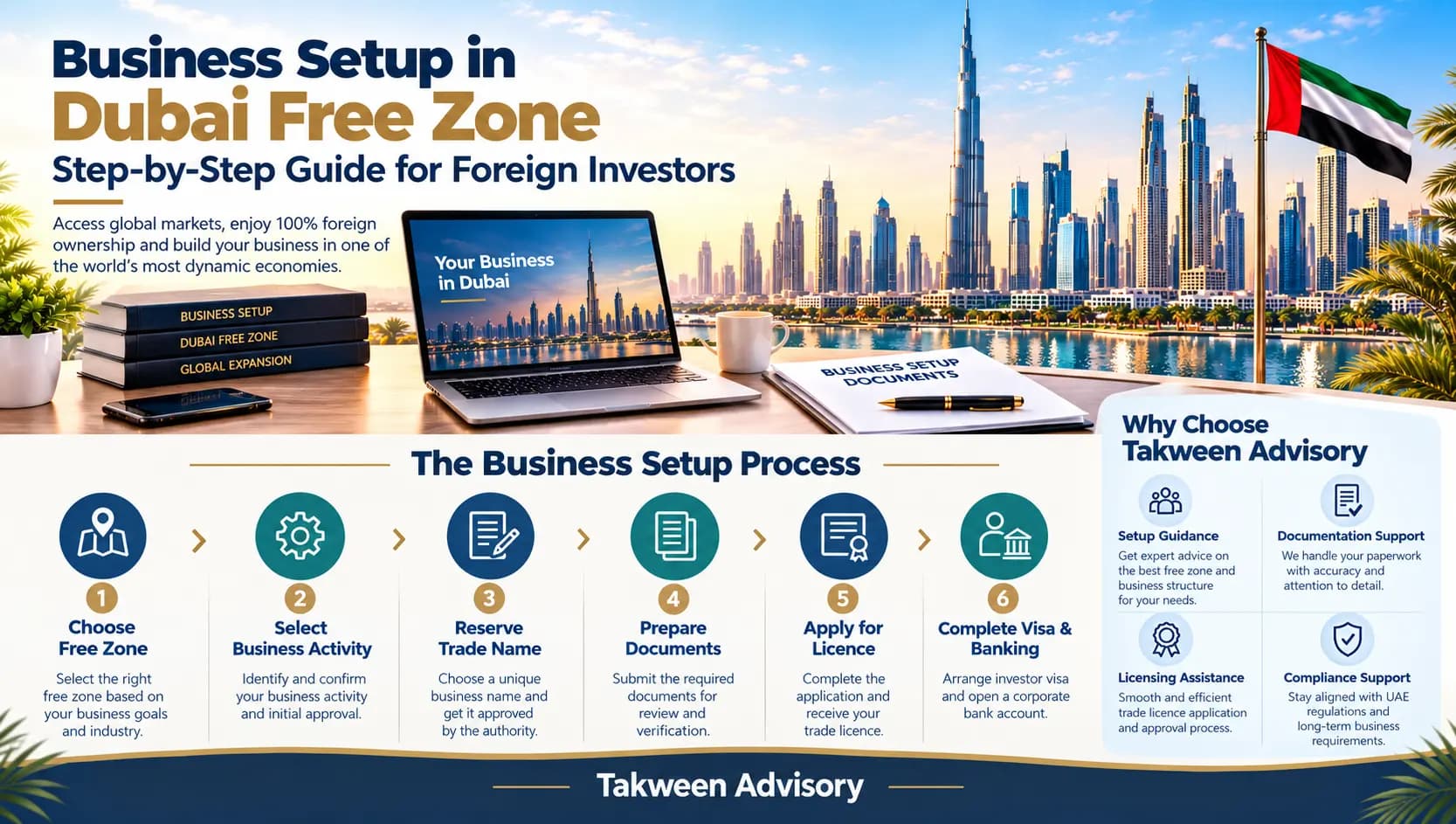
Step-by-Step Process to Set Up a Free Zone Company in Dubai
Step 1: Define Your Business Activity
Your activity decides the zone, the licence and the cost. A consultancy, a trading company, a media business and a manufacturing unit all fall under different licence categories. Be specific, because changing activities after registration costs time and fees.
Step 2: Select the Right Free Zone
Dubai has more than 20 free zones, and each is built for a different type of business. Some are strong for trading and logistics, others for technology, media, finance or professional services. Compare licence cost, visa allowance, office requirements, industry reputation and banking acceptance, not just the headline price.
Step 3: Choose the Legal Structure and Licence Type
Most investors choose between a Free Zone Establishment (FZE) for a single shareholder and a Free Zone Company (FZCO or FZ-LLC) for multiple shareholders. Licences are typically commercial (trading), service, professional, industrial or e-commerce, and some zones allow several activities under one licence.
Step 4: Reserve a Trade Name
Your company name must follow UAE naming rules. It cannot include offensive terms, religious references or the names of government entities, and it must match your licensed activity. Approval is usually quick.
Step 5: Submit Documents and Application
Standard requirements include:
A valid passport copy for each shareholder and director
A recent passport-size photograph
A completed application form and shareholder resolution
A UAE entry stamp or visa copy, where applicable
Proof of address and a no-objection certificate (NOC) in some cases
Corporate shareholders will also need incorporation documents attested to the UAE's requirements. Takween Advisory helps clients prepare these files correctly so that they are not returned for corrections.
Step 6: Pay Fees and Receive the Licence
After approval and payment, the free zone issues your trade licence, memorandum of association and share certificate. Your lease agreement or flexi-desk contract is typically issued at the same stage.
Step 7: Apply for Visas and Emirates ID
Once the licence is active, you can obtain an establishment card and apply for investor, partner and employee visas, subject to your quota. Medical tests, biometrics and Emirates ID issuance follow.
Step 8: Open a Corporate Bank Account
Bank onboarding is often the slowest step. Banks review the business model, the source of funds, the ownership structure and the shareholders' background, so a clear business plan and supporting documents matter. Takween Advisory guides clients on how to present their company so that the application is credible and complete.
Free Zone vs Mainland: Which Is Better for Foreign Investors?
When a Free Zone Fits
A free zone suits businesses that serve international clients, trade across borders, operate online, or want a low-overhead UAE presence. It also suits investors who prioritise tax planning and full ownership above local retail access.
When Mainland Fits
Mainland licensing allows direct trade with UAE customers and government entities, and has no geographic restriction inside Dubai. Many businesses use both: a free zone entity for international activity and a mainland licence for local sales.
Cost of Business Setup in Dubai Free Zone
Costs vary by free zone, licence type, number of visas and office package. A realistic budget for a business setup in Dubai free zone usually includes the items below.
Trade licence and registration: AED 12,000 – 25,000 for most mainstream zones; premium zones can be higher
Flexi-desk or shared office: AED 0 – 10,000 per year, and sometimes bundled into the licence package
Dedicated office or warehouse: AED 15,000 – 60,000+ per year, depending on size and location
Establishment card: AED 2,000 – 2,500
Investor or employee visa: AED 3,500 – 6,500 per visa, including medical, Emirates ID and processing
Corporate bank account: AED 0 – 2,000 in application fees, plus minimum balance requirements set by the bank
Annual licence renewal: Usually similar to the first-year licence cost
Professional and advisory support: Varies by scope; request a written quotation
For a lean first year, many solo founders spend roughly AED 20,000 to AED 35,000 including one visa, though this changes with the zone and activity.
Important Disclaimer
The cost prices stated above are baseline estimates and are subject to market fluctuations, supplier changes and variable logistics fees. Free zone authorities, banks and government departments may revise their charges at any time. For the latest and most accurate prices for your specific activity and visa requirements, please contact Takween Advisory directly.
Documents and Compliance Requirements
Registration is only the beginning. Free zone companies must renew their licence annually, maintain a valid office lease, file the required corporate tax registration and returns, and keep proper accounting records. VAT registration is required when taxable supplies exceed AED 375,000 and is optional above AED 187,500. Ultimate beneficial owner (UBO) details must be kept current. Missing a deadline can bring fines or, in some cases, licence suspension, so most foreign owners prefer to work with an experienced advisor on an ongoing basis.
Tax Position for Free Zone Companies
The UAE levies 9% corporate tax on taxable profits above AED 375,000. A company that qualifies as a Qualifying Free Zone Person may benefit from a 0% rate on qualifying income, such as certain export and international activity, provided it meets substance, accounting and de minimis conditions. Income from non-qualifying activity is taxed at the standard rate. The rules are technical, so structure your activities with professional advice before you apply for a licence, not afterwards.
Common Mistakes Foreign Investors Make
Choosing a free zone on price alone and later discovering that banks or clients do not accept it
Registering a vague activity, which restricts what the company can legally invoice
Underestimating visa needs and having to upgrade office space later
Ignoring corporate tax registration and bookkeeping duties
Expecting to trade locally on a free zone licence without a proper mainland arrangement
How Takween Advisory Supports Your Free Zone Setup
Takween Advisory supports investors from the first consultation to the first invoice. We help you compare zones against your actual business model, prepare and submit documents, coordinate visas and Emirates ID, assist with bank onboarding and set up accounting and compliance routines. Our approach is simple: give you a transparent, written plan with realistic timelines, so you know what to expect at every stage.
Conclusion
A well-planned business setup in Dubai free zone gives foreign investors a fast, ownership-friendly route into the UAE market, but the outcome depends on the early decisions: the zone, the licence, the visa plan and the banking approach. Take time to match the structure to your business, budget for the full first year rather than the licence alone, and keep your compliance in order from day one. To discuss your plan and get a tailored quotation, speak with the Takween Advisory team.
Frequently Asked Questions
1. Can a foreigner own 100% of a company in a Dubai free zone?
Yes. Free zones allow full foreign ownership, with no local sponsor required.
2. How long does it take to set up a free zone company in Dubai?
Once documents are complete, a licence can often be issued within 3 to 10 working days. Visas, Emirates ID and bank account opening usually extend the full process to two to four weeks.
3. Do I need to be in Dubai to register a free zone company?
Many zones allow remote application and document signing. However, you will normally need to visit for biometrics, medical tests and Emirates ID, and some banks require an in-person meeting.
4. Can a free zone company do business in the UAE mainland?
Not directly in most cases. You can work through a distributor, obtain a dual licence where offered, or open a mainland branch.
5. Do free zone companies pay tax?
They are subject to UAE corporate tax rules. Qualifying income may be taxed at 0%, while other income is taxed at 9% above the threshold. VAT applies where registration thresholds are met.
6. How many visas can I get with a free zone licence?
This depends on your office package and the zone's rules. Flexi-desk packages usually come with a small quota, while larger offices allow more.
7. Is a physical office compulsory?
Requirements vary. Many zones offer flexi-desk or virtual options, while industrial and trading activities may need a physical unit or warehouse.
8. How much does it cost to renew a free zone licence?
Renewal fees are generally close to the first-year licence cost, plus visa and lease renewals. Contact Takween Advisory for current renewal pricing for your zone.