
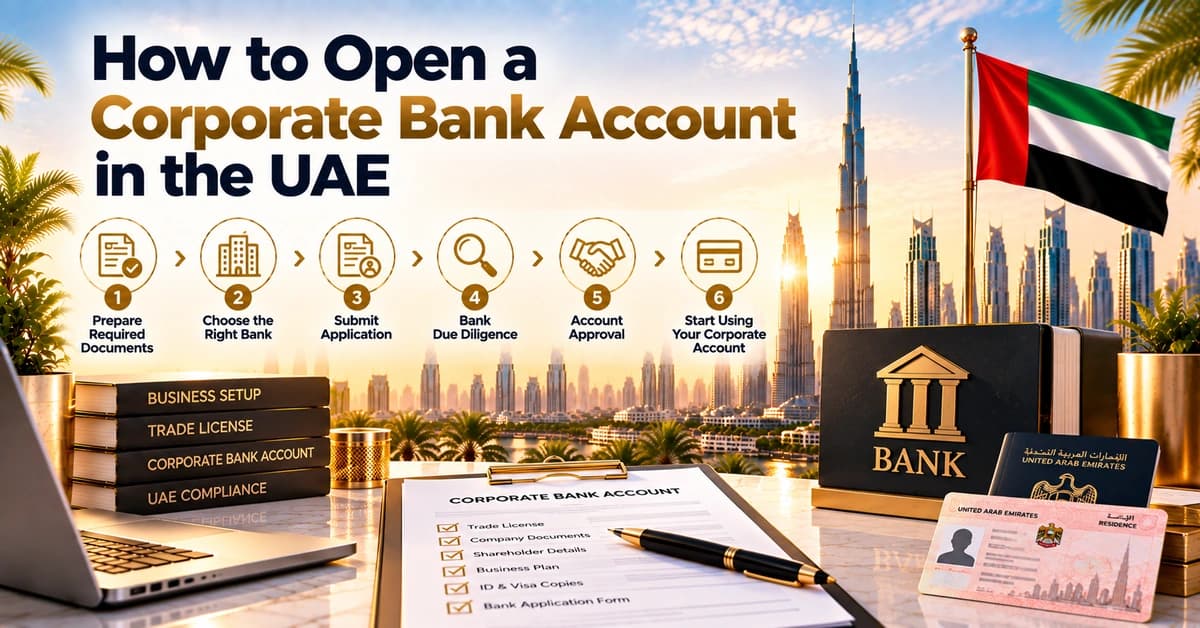
A corporate bank account is the financial backbone of your UAE company. It lets you receive client payments, pay suppliers, run payroll and keep your business finances separate from your personal money. Without it, even a fully licensed company cannot operate smoothly.
Many founders focus on the trade license and visas, then discover that banking is a separate process with its own costs, requirements and timelines. This is why banking should always be part of your budget when you calculate the cost to start a business in Dubai. At Company Setup Consultant, we guide entrepreneurs through company formation and banking preparation together, so there are fewer surprises after the license is issued.
Why a Corporate Bank Account Matters for Your UAE Company
Opening a business account is more than a formality. It supports several core parts of your operation:
Receiving payments from local and international clients.
Paying salaries through the UAE Wages Protection System where applicable.
Paying government fees, rent and supplier invoices.
Meeting VAT and corporate tax record keeping needs.
Building a banking history that helps with future credit and financing.
Banks in the UAE follow strict anti-money laundering and know your customer rules. That means they review your company, your shareholders and your business model carefully before approving an account.
How Much Does It Cost to Open a Corporate Bank Account in the UAE?
Bank account costs are usually a small part of your total budget, but they are worth planning for. When you estimate the business setup cost in Dubai, include these banking related items:
Banking Cost | What It Covers | Indicative Range (AED) |
|---|---|---|
Account opening fee | One-time fee charged by some banks | 0 to 1,000 |
Minimum balance | Amount you must maintain to avoid monthly fees | 10,000 to 100,000 or more |
Monthly maintenance fee | Charged if balance falls below the required level | 50 to 500 |
Cheque book and online banking | Optional services and tokens | Varies by bank |
Advisory or facilitation fee | If you use a consultant to prepare your application | Varies by provider |
These are indicative ranges and they differ by bank and account type. For a full view of every fee involved in launching your company, our detailed breakdown of the cost to start a business in Dubai covers license, office, visa and other charges line by line.
Step 1: Complete Your Company Formation First
You cannot open a corporate account until your company legally exists. Banks will want to see an active trade license and supporting company documents. If you are still deciding on your structure, it helps to understand the difference between a mainland company setup in Dubai and a free zone structure, since banks assess each differently.
Mainland companies often find it easier to satisfy banks that expect a physical office and local presence. Free zone companies are widely accepted too, but some banks ask for extra clarity on the business model and where your revenue comes from.
Step 2: Choose the Right Type of Bank Account
Not every business needs the same account. The main options include:
Traditional bank accounts: Offered by established UAE banks, these usually come with full service features, credit facilities and relationship managers.
Digital business accounts: Offered by newer digital banks and fintech platforms, these often have faster onboarding and lower fees, but may have limits on certain services.
Multi-currency accounts: Useful if you invoice clients in dollars, euros or other currencies.
Your choice should reflect your transaction volume, client locations, expected cash flow and growth plans. A trading business with imports and exports has different needs from a consultancy that invoices a few clients each month.
Step 3: Prepare the Documents Required by the Bank
Complete, consistent documentation is the single biggest factor in a smooth application. Banks commonly ask for:
Valid trade license and its renewal certificate.
Memorandum or Articles of Association, with any amendments.
Certificate of incorporation or registration (for free zone companies).
Ejari or tenancy contract, or free zone facility agreement.
Passport copies, Emirates ID and residence visa of the owners and signatories.
Proof of address for shareholders.
Company profile or business plan describing your activity.
Board resolution authorising the account opening, where applicable.
Contracts, invoices or proof of source of funds and expected transactions.
Requirements vary by bank and by your company structure. You can prepare in advance by reviewing the general documents required for business setup in the UAE, then confirming the bank specific list before you submit.
Step 4: Get Your Residence Visa Sorted
Many banks prefer, and some require, that the account signatory holds a valid UAE residence visa and Emirates ID. Non-resident applications are possible with some banks, but they usually involve stricter checks and higher minimum balances.
If you plan to live in the UAE, completing your visa early makes banking easier. Our guide on how to get a UAE residence visa through your own company explains the full process from license to Emirates ID.
Step 5: Submit the Application and Complete the Bank Review
Once your documents are ready, the process usually looks like this:
Initial application: You or your consultant submit the application and documents to the bank.
Compliance review: The bank checks your company, shareholders, business activity and source of funds.
Interview or clarification: Some banks ask for a meeting or additional explanation about your business model.
Account approval: After approval, the bank issues account details and sets up online banking.
Initial deposit: You fund the account to meet the minimum balance requirement.
Timelines depend on the bank, your business profile and how complete your file is. Straightforward applications may be processed within a couple of weeks, while complex structures with international shareholders can take longer.
Why Corporate Bank Account Applications Get Delayed or Rejected
Banks are cautious, and rejections do happen even to genuine businesses. The most common reasons include:
Unclear or vague business activity description.
Mismatch between the trade license activity and the actual business.
Missing or inconsistent documents.
Shareholders based in higher risk jurisdictions.
Lack of proof of source of funds.
Virtual or shared office setups that the bank considers too thin.
Applying to too many banks at once, which can leave multiple inquiries on record.
A well prepared application, with a clear business model and supporting evidence such as contracts or client details, greatly improves your chances. Choosing a sensible business activity from the start also helps, and your consultant can guide you when selecting the license activity that matches how you will actually earn revenue.
How Your License Type Affects Banking
Your license is the foundation of your banking application. The activity listed on it should match your real operations, because banks compare the two. If you are still at the licensing stage, professional trade license services in Dubai can help you select an activity and structure that supports both your business plan and your future banking needs.
Tips to Improve Your Chances of Approval
From our experience supporting founders at Company Setup Consultant, these practical steps make a real difference:
Keep your business description clear, specific and consistent across all documents.
Prepare a short company profile explaining what you sell, who your customers are and where they are located.
Gather proof of income, contracts or sample invoices where possible.
Ensure all shareholders and signatories have valid IDs and up to date documents.
Maintain a realistic initial deposit that meets the bank's expectations.
Apply to one or two well matched banks rather than many at once.
Respond to bank queries quickly and honestly.
Ongoing Banking and Compliance After Opening Your Account
Opening the account is only the beginning. You should also keep your records clean and stay compliant with VAT, corporate tax, accounting and license renewal duties. Working with dedicated business support services in Dubai can simplify bookkeeping, PRO work and regulatory filings, which in turn keeps your banking relationship healthy.
Why Choose Company Setup Consultant
Banking and company formation are regulated, high stakes steps. Company Setup Consultant provides transparent guidance, realistic timelines and step by step support from license issuance through to banking readiness. We explain each cost before you commit and help you prepare a clean, complete file so your application has the best possible chance.
Frequently Asked Questions
Q: How long does it take to open a corporate bank account in the UAE?
A: Timelines vary by bank and company profile. Straightforward applications with complete documents may take one to three weeks, while complex structures or non-resident shareholders can take longer.
Q: Can I open a corporate bank account without a residence visa?
A: Some banks allow non-resident applications, but they usually apply stricter checks and higher minimum balances. Holding a UAE residence visa and Emirates ID generally makes approval easier.
Q: Is the bank account included in the cost to start a business in Dubai?
A: Usually not. The bank account is a separate process with its own requirements, minimum balance and fees. It should be included in your overall budget so you are not caught off guard after your license is issued.
Q: What documents do I need to open a business bank account?
A: Common documents include the trade license, Memorandum of Association, tenancy contract or facility agreement, passport and Emirates ID copies, proof of address and a company profile. Each bank may ask for additional items.
Q: Why was my corporate bank account application rejected?
A: Common reasons include unclear business activity, missing documents, mismatch between license and actual operations, or difficulty verifying the source of funds. A stronger, well documented application can help on reapplication.
Q: Can free zone companies open bank accounts in the UAE?
A: Yes. Free zone companies can open accounts with UAE banks, provided they meet the bank's compliance requirements and can clearly explain their business model and revenue sources.
Q: What is the minimum balance for a corporate account in the UAE?
A: It varies by bank and account type. Many traditional business accounts require a minimum balance from about AED 10,000 to AED 100,000 or more, while some digital accounts have lower requirements.
Get Your Company Banking Ready the Right Way
Want to open your UAE business account without delays or rejections? The team at Company Setup Consultant will review your business activity, structure and documents, then guide you through company formation and banking preparation with a clear, itemised quote. We handle the paperwork, coordination and follow ups so you can focus on running your business. Contact Company Setup Consultant today for a free consultation and start your UAE journey with confidence.