
Overview
Dubai has become one of the most attractive places in the world to structure business ownership. The combination of full foreign ownership, a growing network of double tax treaties, strong banking access and a tax regime that rewards well-organised groups makes the emirate a natural base for investors. A holding company sits at the top of that structure. It does not usually sell products or services. Instead, it owns shares in operating companies, real estate, intellectual property or investment portfolios, and it receives dividends and capital gains from them.
Since the introduction of UAE corporate tax, a properly planned holding company setup Dubai investors rely on has become even more relevant. Choosing the wrong jurisdiction or legal form can create unnecessary tax exposure, banking delays or compliance gaps. At Takween Advisory, we regularly see founders who incorporated first and planned later, then had to restructure at extra cost. This guide is designed to help you get it right the first time.
Key Takeaways
A holding company owns assets and shares in other businesses and generally does not trade itself.
You can form one on the mainland, in a free zone, or in an offshore jurisdiction, and each option carries different advantages.
UAE corporate tax applies at 9% on taxable profits above AED 375,000, though qualifying dividends and capital gains can be exempt under the participation exemption.
Setup costs vary widely by jurisdiction, so early planning saves money.
Bank account opening and corporate tax registration are mandatory steps that many founders underestimate.
Professional guidance from Takween Advisory helps align legal structure, tax position and long-term goals.
Quick Answer
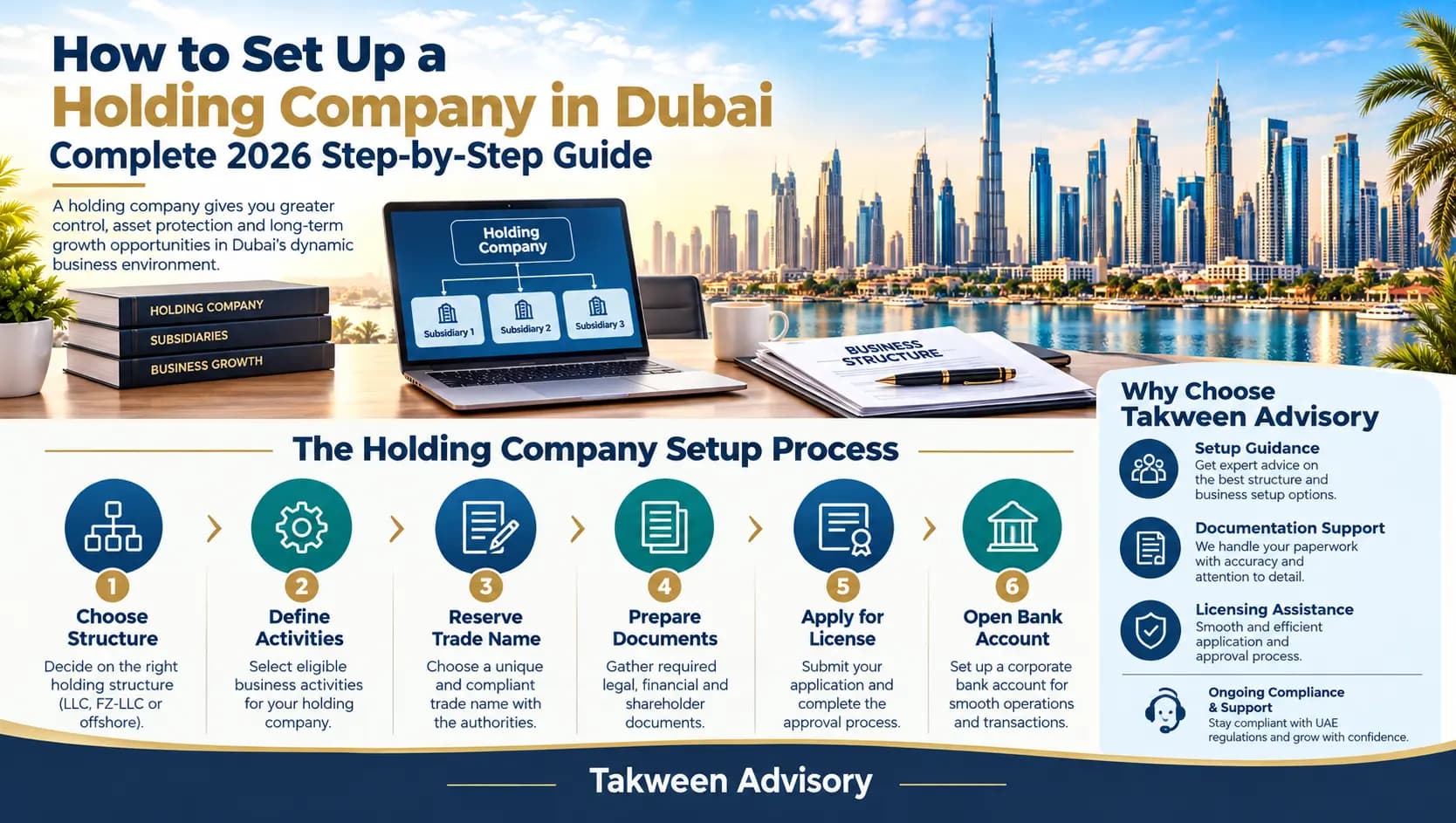
To complete a holding company setup Dubai entrepreneurs should choose a jurisdiction (mainland, free zone or offshore), select a legal form, obtain the licence, open a corporate bank account, register for corporate tax and then transfer ownership of subsidiaries into the new entity.
What Is a Holding Company and Why Use One in Dubai?
A holding company is a legal entity created mainly to own and control other assets. These assets can include shares in operating companies, commercial or residential property, trademarks, patents or investment portfolios. The operating businesses beneath it carry the day-to-day risk, while the holding company keeps the valuable assets one step removed from that risk.
Entrepreneurs in Dubai typically choose this structure for several reasons. The first is asset protection, because a claim against one subsidiary does not automatically reach the assets held elsewhere in the group. The second is succession and inheritance planning, since transferring shares in a single holding entity is far simpler than dividing many separate businesses. The third is tax efficiency, because dividends and gains flowing up to the holding company can qualify for exemptions. The fourth is credibility, as banks, investors and partners often find a clean group structure easier to assess.
Types of Holding Company Structures in Dubai
There is no single best structure. The right answer depends on your activities, your investors and your goals. The three main routes are described below.
Mainland Holding Company
A mainland holding company is licensed by the Dubai Department of Economy and Tourism. Following the reforms to commercial company law, most activities now allow full foreign ownership, so a local partner is no longer required for many businesses. A mainland structure is a sensible option if the holding company will own Dubai-based operating businesses, hold property in the emirate, or needs to contract directly with local entities and government bodies without restriction.
Free Zone Holding Company
Free zones such as DMCC, DAFZA, IFZA and Meydan offer holding company licences with simple processes, flexible office options and 100% foreign ownership. Many founders prefer them for speed and cost control. If the company qualifies as a Qualifying Free Zone Person, it may benefit from a 0% corporate tax rate on qualifying income, provided it meets the substance, accounting and audit requirements set by the authorities.
DIFC and Offshore Options
The Dubai International Financial Centre operates under its own common law framework and is well suited to sophisticated family offices, fund structures and international investors who want English-style legal certainty. It offers special purpose vehicle and prescribed company options designed for holding assets. Offshore vehicles, such as those available through JAFZA or Ras Al Khaimah International Corporate Centre, can also serve certain holding purposes, although they come with restrictions on trading inside the UAE and warrant careful review of banking and substance considerations.
UAE Corporate Tax and the Holding Company
Understanding tax treatment is essential before you commit to a structure. UAE corporate tax applies at 9% to taxable income above AED 375,000, with a 0% rate on profits up to that threshold. For holding companies, the participation exemption is often the most valuable feature. In broad terms, dividends and capital gains from a qualifying shareholding can be exempt where the holding company owns at least 5% of the subsidiary, has held it for at least 12 months, and the subsidiary is subject to a comparable level of tax.
Every holding company, including one that expects no taxable income, must still register with the Federal Tax Authority and file annual returns. VAT registration becomes mandatory once taxable supplies exceed AED 375,000, though pure share ownership generally does not generate taxable supplies. Because the rules around qualifying income and substance are detailed, Takween Advisory recommends reviewing your exact facts before filing any registration.
Step-by-Step Process to Set Up a Holding Company in Dubai
Step 1: Define Your Objectives and Asset Mix
Start by listing what the holding company will own: subsidiaries, property, intellectual property or investments. Note where those assets are located, who the shareholders will be and whether you plan to bring in investors later. These answers drive every decision that follows.
Step 2: Choose the Jurisdiction
Compare mainland, free zone and DIFC or offshore options against your objectives. A holding company owning only international subsidiaries often suits a free zone or DIFC, while one owning Dubai trading businesses may be better placed on the mainland.
Step 3: Select the Legal Form and Company Name
Common forms include a limited liability company, a free zone company (FZ-LLC or FZCO) and a special purpose vehicle. Reserve a trade name that complies with naming rules, avoiding restricted words and names already in use.
Step 4: Obtain Initial Approval
The licensing authority issues an initial approval confirming that the proposed activity and name are acceptable. For a holding company the activity is typically listed as a holding or investment activity, depending on the authority.
Step 5: Draft the Constitutional Documents
Prepare the Memorandum and Articles of Association or the equivalent free zone documents. This is the stage to settle shareholder rights, management authority, share classes, profit distribution and exit provisions. Well-drafted documents prevent disputes later, especially in family-owned groups.
Step 6: Secure Office Space and Obtain the Licence
Depending on the jurisdiction, you may need a physical office, a flexi-desk or a registered address. Pay the licence fees, sign the lease or registration agreement, and receive your trade licence along with the certificate of incorporation.
Step 7: Open a Corporate Bank Account
Banks in the UAE apply thorough due diligence to holding companies, particularly where ownership is layered or spread across several countries. Prepare a clear structure chart, details of the ultimate beneficial owners, the source of funds and a business plan. Takween Advisory helps clients assemble these documents so the process moves more smoothly.
Step 8: Register for Corporate Tax and Complete Compliance Filings
Register with the Federal Tax Authority, file the ultimate beneficial owner information with the licensing authority, and set up proper bookkeeping. Where audited accounts are required, appoint a registered auditor early in the year rather than at the deadline.
Step 9: Transfer Subsidiaries and Assets into the Holding Company
Finally, transfer shares or assets into the new entity through formal share transfer agreements and updated registers. Depending on the nature of the transfer, some reorganisations can be done without triggering tax, so seek advice before executing any transfer.
Holding Company Setup Cost Breakdown in Dubai
Costs depend on the jurisdiction, licence type, office arrangement and professional support required. The figures below are typical baseline ranges for a holding company setup Dubai investors can use for early budgeting.
Free zone holding licence (first year): AED 12,000 – 30,000
Mainland holding licence and registration: AED 15,000 – 40,000
DIFC special purpose vehicle or prescribed company: AED 20,000 – 55,000
Office or flexi-desk arrangement (annual): AED 3,000 – 25,000
Memorandum and Articles drafting and legal review: AED 3,000 – 10,000
Corporate bank account opening support: AED 2,000 – 6,000
Corporate tax registration and annual filing: AED 2,500 – 8,000
Annual audit (where required): AED 5,000 – 20,000
Investor or manager visa (per person): AED 4,000 – 8,000
Important Disclaimer
The cost prices shown above are baseline estimates and are subject to market fluctuations, supplier changes and variable logistics fees. Government charges, authority fees and service provider rates can change without notice. For the latest and most accurate prices tailored to your structure, please contact Takween Advisory directly.
Common Mistakes to Avoid
The most frequent error is choosing a jurisdiction based on the lowest price instead of the long-term structure. A cheap licence that cannot own property, or that creates banking friction, often costs more to fix than it saved. Another common mistake is ignoring substance requirements, especially for groups hoping to benefit from free zone tax advantages. Founders also underestimate the time required for bank account opening, which can take several weeks when ownership is complex. Finally, some owners skip proper shareholder agreements, leaving the group exposed to disputes when family members or partners disagree.
Why Work with Takween Advisory
A holding company is a long-term decision, and the quality of the planning at the start determines how smoothly the group operates for years. Takween Advisory supports entrepreneurs and investors across the full journey, from comparing jurisdictions and drafting constitutional documents to coordinating banking, tax registration and ongoing compliance. Our approach is practical and Dubai-specific, focused on structures that work in real life with real banks and real regulators, not just on paper.
Conclusion
A well-planned holding company can protect your assets, simplify succession and create a tax-efficient base for growth. The key is matching the structure to what you own, where it operates and how you intend to grow. Start with clear objectives, choose the jurisdiction deliberately, and keep your compliance in order from day one. If you are ready to take the next step, Takween Advisory is available to guide you through each stage.
Frequently Asked Questions
1. What is the main purpose of a holding company in Dubai?
Its main purpose is to own shares, property or intellectual property rather than trade directly. This separates valuable assets from operating risk and can simplify ownership, succession and tax planning.
2. Can a foreigner own 100% of a holding company in Dubai?
Yes. Free zones have long allowed full foreign ownership, and mainland rules now permit it for most activities. Some regulated sectors may still have specific requirements.
3. Is a free zone or mainland holding company better?
Neither is better in every case. Free zones are often faster and cheaper to set up, while mainland structures suit groups that own Dubai-based operating businesses or need unrestricted local contracting. Your asset mix should decide.
4. Does a holding company have to pay corporate tax in the UAE?
It must register for corporate tax and file returns. Qualifying dividends and capital gains can be exempt under the participation exemption, and income above AED 375,000 that is not exempt is taxed at 9%.
5. How long does it take to set up a holding company in Dubai?
Free zone and mainland licences can often be issued within one to three weeks once documents are complete. Bank account opening usually takes longer, particularly for multi-layered ownership.
6. Do I need a physical office?
It depends on the authority. Many free zones accept flexi-desks or registered addresses, while some mainland and DIFC structures have specific premises or substance expectations.
7. Can a holding company own property in Dubai?
Yes, subject to the rules of the licensing authority and the freehold areas where foreign ownership is permitted. The correct entity type matters, so confirm this before purchasing.
8. Can I get a UAE residence visa through a holding company?
Generally yes. A licensed holding company can sponsor investor and manager visas, with the number depending on the licence type and office arrangement.
9. What documents are needed to register a holding company?
Typically passport copies, proof of address, shareholder details, ultimate beneficial owner information and a proposed company name. Corporate shareholders must also provide their own incorporation documents.
10. How can Takween Advisory help with the process?
Takween Advisory assists with jurisdiction selection, document drafting, licensing, banking support, tax registration and ongoing compliance, so you can focus on running and growing your businesses.