
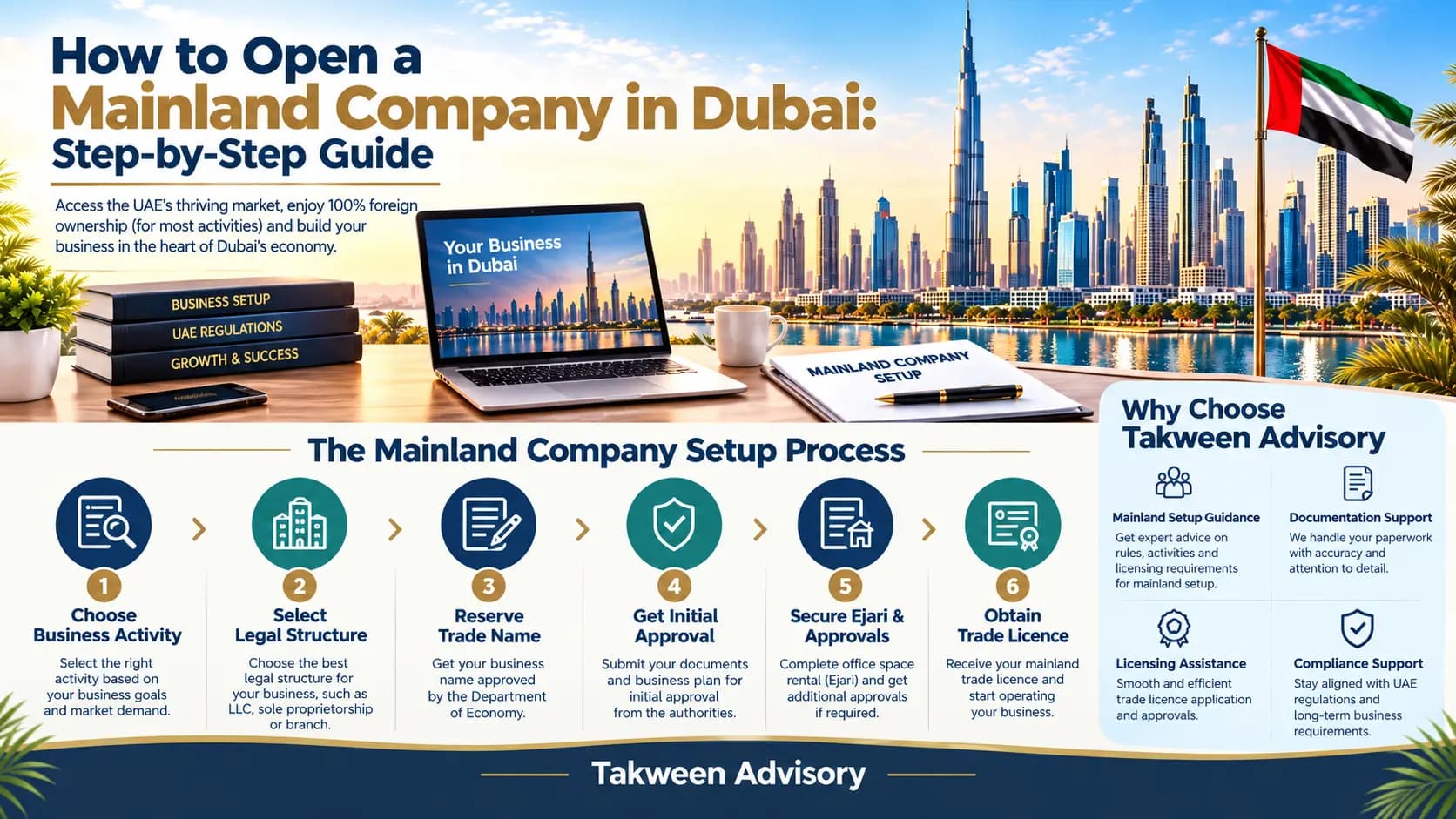
Quick Answer: To open a mainland company in Dubai, choose your business activity and legal structure, reserve a trade name, obtain initial and external approvals, secure a registered office with an Ejari contract, pay the fees to receive your DET trade license, and then complete visas, banking and tax registrations.
Dubai's mainland is where businesses can trade freely across the UAE, bid for government contracts and serve customers directly without a distributor. Since the 2021 reforms, foreign investors can own 100% of most mainland companies, which has made this route far more attractive than it once was. If you are planning to open mainland company in Dubai operations, understanding the sequence of steps and the documents involved will save you time and avoid costly delays. Takween Advisory supports founders through this process, and the guidance below reflects how the setup works in practice.
What Is a Mainland Company in Dubai?
A mainland company is a business licensed by Dubai's Department of Economy and Tourism that can operate anywhere in the UAE. Unlike a free zone entity, it is not restricted to a designated zone and can sell directly to the local market, to other businesses and to government bodies.
Key Takeaways:
Most commercial and professional activities on the Dubai mainland now allow 100% foreign ownership.
Licensing is issued through the Dubai Department of Economy and Tourism (DET), with some activities needing external approvals.
A physical office lease registered through Ejari is generally required.
Total costs depend on the activity, office type, and number of visas.
Corporate tax and VAT registration should be planned from day one.
Mainland vs Free Zone: Which Fits Your Business?
A free zone company suits businesses focused on international trade, remote services or holding structures, since it offers simplified setup and often a lower initial cost. Its limitation is that direct trading within the UAE mainland typically requires a distributor or additional permissions.
A mainland company suits businesses that need a local presence: retail, restaurants, consultancies serving local clients, contractors, trading firms and service providers. The setup requires more documentation and a physical premises, but it provides wider market access. Takween Advisory usually begins client consultations by comparing these two paths against the client's target customers, since the right choice is driven by where revenue will come from.
Step-by-Step Process to Open a Mainland Company in Dubai
Step 1: Define Your Business Activity
Every license is tied to specific activities, which DET classifies as commercial, professional, industrial or tourism-related. Choose the activities that match your real operations, because trading outside your licensed scope can lead to penalties. Some activities, such as healthcare, education, financial services and security, require approvals from additional authorities.
Step 2: Choose the Legal Structure
The most common structure is the Limited Liability Company (LLC), which requires at least one shareholder and suits most trading and service businesses. Other options include sole establishments for individual professionals and civil companies for professional services. Your choice affects liability, ownership, and the documents required, so it should be settled before applying.
Step 3: Reserve a Trade Name
Your company name must follow UAE naming rules. It should not include offensive terms, religious references or names of existing companies, and it generally combines a unique name with a description of the activity. Reservation is done through DET, and it is wise to prepare a few alternatives.
Step 4: Obtain Initial Approval
Initial approval confirms that the government has no objection to your proposed activity and structure. It is not the final license, but it allows you to proceed with the next steps. Some activities need external approvals at this stage from bodies such as the Dubai Municipality, health authorities or other regulators.
Step 5: Secure a Registered Office
A mainland company generally needs physical premises, and the tenancy contract must be registered through Ejari. The size and type of space must suit your activity, so a trading or industrial business will have different requirements than a consultancy. Flexible office arrangements may be accepted for certain activities, which can reduce overheads for early-stage companies.
Step 6: Draft and Sign the Memorandum of Association
The Memorandum of Association (MOA) sets out ownership, capital, management and profit sharing. It is signed by the shareholders and notarized. Because the MOA governs how the company operates, it is worth having it reviewed carefully rather than accepting a generic template.
Step 7: Pay Fees and Receive Your Trade License
Once approvals and documents are complete, you pay the government fees and DET issues the trade license. At this point the company is legally established and can begin operating, subject to the activity's conditions. Timelines vary by activity and approvals, but straightforward cases can complete in a matter of days once documents are ready.
Step 8: Complete Visas, Banking and Registrations
After licensing, you can apply for an establishment card, then residency visas for the owner and employees. You will also open a corporate bank account, which usually involves compliance checks and supporting documents on your business model. Finally, register for corporate tax and, where applicable, VAT.
Documents Typically Required
The exact list depends on the activity, but founders should expect to prepare passport copies and photographs of shareholders and managers, a UAE residence visa copy for residents, a no-objection certificate where applicable, the signed tenancy contract, and the notarized MOA. Documents issued abroad generally need attestation before they are accepted. Takween Advisory reviews this checklist at the start so there are no surprises at submission.
Cost Breakdown to Open a Mainland Company in Dubai
Costs depend on your activity, premises and the number of employees. The following are typical baseline estimates for a standard small company:
Trade license and government registration fees: approximately AED 10,000 – 20,000, depending on the activity and legal form
Trade name reservation and initial approval: approximately AED 600 – 1,500
Office or flexi-desk lease with Ejari registration: approximately AED 6,000 – 30,000 per year, depending on size and location
MOA drafting and notarization: approximately AED 1,500 – 4,000
External activity approvals (if required): approximately AED 500 – 5,000
Establishment card and typing/service charges: approximately AED 1,500 – 3,000
Residency visa per person (including medical and Emirates ID): approximately AED 3,000 – 5,000
Professional advisory and PRO service fees: variable, depending on the scope of support
Important Disclaimer
The cost prices listed above are baseline estimates only and are subject to market fluctuations, supplier changes and variable logistics fees. Government charges, office rents and approval costs may change without notice. For the latest and most accurate prices tailored to your business activity, please contact Takween Advisory directly.
Compliance Obligations After Setup
Setting up is only the beginning. Dubai companies must renew their trade license annually and keep their Ejari and visas current. Corporate tax applies at 9% on taxable profits above AED 375,000, and businesses must register with the Federal Tax Authority. VAT registration is mandatory once taxable supplies exceed AED 375,000 annually, and voluntary registration is possible above AED 187,500. Maintaining proper accounting records is essential for both tax filings and audits.
Common Mistakes to Avoid
Many founders choose a license activity that does not match what they actually plan to do, and then face restrictions later. Others underestimate the office requirement or delay the corporate bank account application, which can take longer than expected. Skipping tax registration is another costly oversight. Working with an experienced consultant such as Takween Advisory helps you anticipate these issues, as guidance is based on current rules and real application experience.
How Takween Advisory Can Help
Takween Advisory assists entrepreneurs from the first consultation to the day the business is ready to trade. This includes recommending the right structure, preparing documents, coordinating approvals, arranging premises, handling visas and supporting bank and tax registrations. If you want to open mainland company in Dubai without navigating multiple government portals on your own, a structured advisory process can reduce delays and give you a clearer picture of the total investment.
Conclusion
The Dubai mainland gives businesses direct access to local customers, government contracts and the wider UAE market, with full foreign ownership available for most activities. The process is clear once you understand its sequence: define the activity, choose the structure, obtain approvals, secure premises, and complete licensing and post-licensing steps. With careful planning and expert support from Takween Advisory, you can open mainland company in Dubai operations with confidence and remain compliant as your business grows.
Frequently Asked Questions
1. Can a foreigner own 100% of a mainland company in Dubai?
Yes. Following the 2021 reforms, most commercial and professional activities allow full foreign ownership. A few strategic activities still have conditions, so the permitted ownership depends on your chosen activity.
2. How long does it take to set up a mainland company in Dubai?
Simple cases can be completed within a few working days once documents and approvals are ready. Activities requiring external approvals or special premises take longer.
3. Is a physical office mandatory?
In most cases, yes. A registered tenancy contract through Ejari is generally required, though some activities may qualify for flexible arrangements.
4. Is there a minimum capital requirement?
For most LLC activities there is no fixed minimum capital, but certain regulated sectors may have specific requirements. Your MOA should state the capital appropriate to your business.
5. How much does it cost to open a mainland company in Dubai?
Costs depend on your activity, office and visa needs, and typically start from the low tens of thousands of dirhams. Please contact Takween Advisory for the latest and most accurate pricing.
6. What is the difference between a mainland and a free zone license?
A mainland license allows you to trade anywhere in the UAE and with government entities. A free zone license is usually limited to operating within the zone or internationally, unless extra permissions are obtained.
7. Do I need to pay corporate tax on a mainland company?
Yes. Corporate tax at 9% applies to taxable profits above AED 375,000, and companies must register with the Federal Tax Authority.
8. Can I get a residency visa through my mainland company?
Yes. Once the company is licensed and an establishment card is issued, the owner and employees can apply for residency visas, subject to the visa quota tied to your office space and activity.
9. Is a local service agent still required?
For most activities, no. Since 2021 a local sponsor is no longer required for the majority of commercial activities, though certain sectors may have specific conditions.
10. Can Takween Advisory manage the entire setup?
Yes. Takween Advisory can guide you through structuring, approvals, licensing, visas and registrations so that you can focus on running your business.