
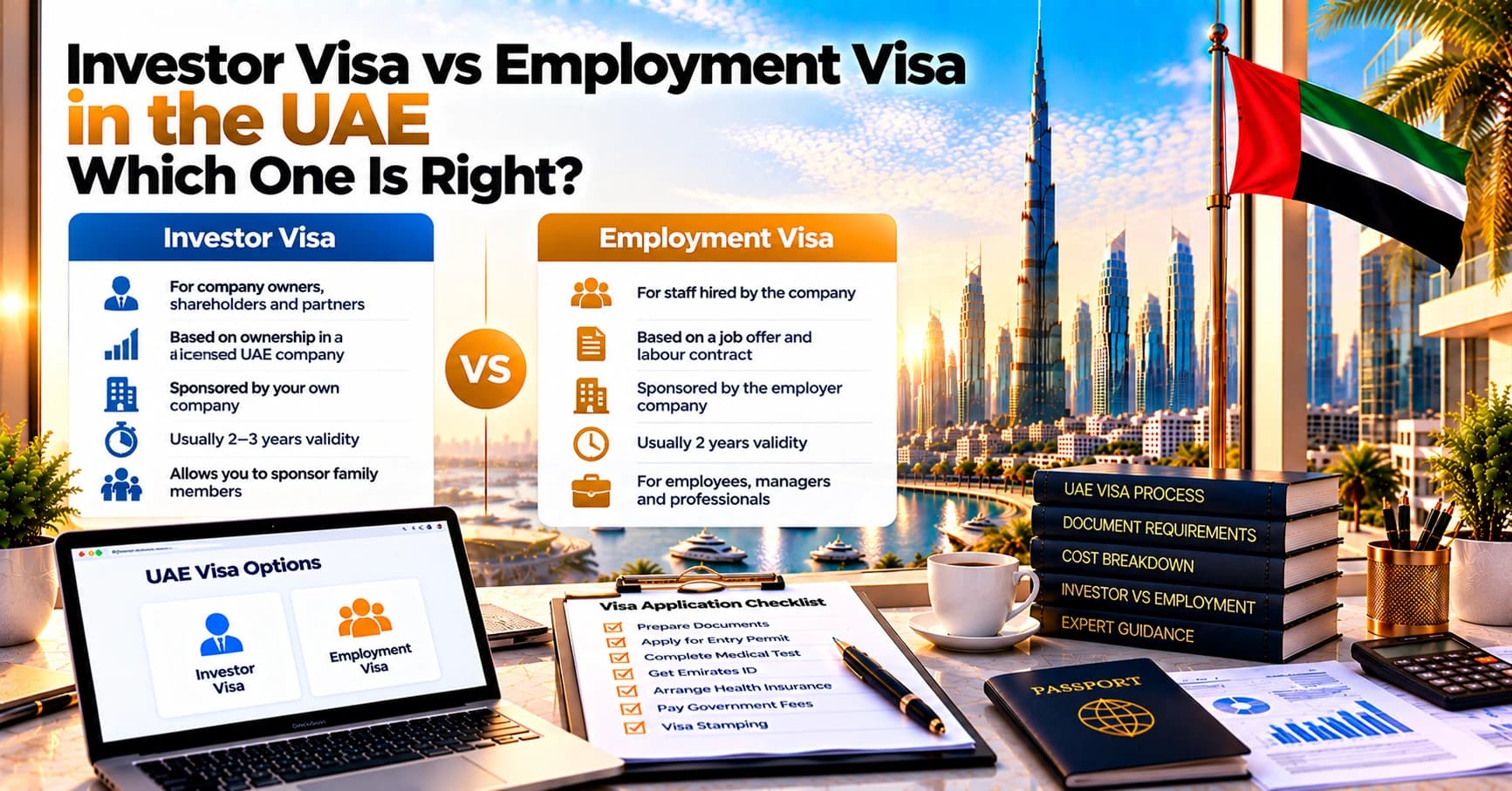
When you set up a company in the UAE, visas are one of the biggest decisions after the license itself. Founders often ask the same question: should I apply for an investor visa for myself and an employment visa for my team, and how do they differ? The answer affects your paperwork, your budget and the cost to start a business in Dubai, because visa fees and quotas form a major part of your first year expenses.
At Company Setup Consultant, we help owners, partners and employers plan their visas before they choose an office or package. Here is a quick comparison to get you started.
Factor | Investor Visa | Employment Visa |
|---|---|---|
Who it is for | Company owners, shareholders and partners | Staff hired by the company |
Basis of eligibility | Ownership in a licensed UAE company | Job offer and labour contract |
Sponsor | The company in which you hold shares | The company as employer |
Typical validity | Often two to three years, subject to rules | Often two years, subject to rules |
Quota impact | Uses part of the company visa allowance | Uses part of the company visa allowance |
Labour contract | Usually not required for owners | Required |
Best for | Founders who want residency through their business | Employees, managers and hired professionals |
An investor visa is for people who own shares in a UAE company, while an employment visa is for people the company hires as staff. Both are issued under the company's visa quota, both require medical tests, Emirates ID and insurance, and both depend on the company holding a valid license and establishment card.
What Is an Investor Visa in the UAE?
An investor visa, sometimes called an owner or partner visa, allows a shareholder in a UAE company to live in the country under the company's sponsorship. Your residency is linked to your ownership stake, not to an employer.
Typical features:
You must be a registered shareholder or partner in a licensed company
The company needs a valid trade license and establishment card
The visa is issued through the relevant mainland or free zone authority
Requirements can include minimum share capital or property criteria in some cases
It allows you to sponsor eligible family members, subject to income and housing rules
Rules differ between mainland and free zone companies, and between emirates, so confirm the requirements for your chosen jurisdiction. You can also read our broader overview of getting a UAE residence visa through a company.
What Is an Employment Visa in the UAE?
An employment visa is issued to a person hired by a UAE company. The company acts as the employer and sponsor, and the worker holds a labour contract. In mainland companies, the process typically involves the Ministry of Human Resources and Emiratisation and immigration authorities. Free zone companies follow their own authority's process.
Typical features:
A signed job offer and employment contract
A work permit linked to the company's labour file
Medical fitness test, biometrics and Emirates ID
Health insurance as required by the emirate
Visa validity linked to the employment relationship
If the employee leaves, the visa must be cancelled or transferred, so the employer must manage visa status carefully.
Investor Visa vs Employment Visa: Key Differences
1. Who Qualifies
Only owners and partners can apply for an investor visa. Employees, managers and hired staff use employment visas. In some cases, an owner who also works in the company may hold an investor visa while performing management duties, but this depends on the structure and authority rules.
2. Legal Relationship
An investor visa is tied to ownership. An employment visa is tied to a labour relationship. This affects your rights, responsibilities and how the visa is cancelled or changed.
3. Documents Required
Both need passport copies, photographs, medical results and Emirates ID processing. Investor visas additionally need proof of ownership such as share certificates or the memorandum of association. Employment visas need a labour contract and job details. Our guide on the UAE visa medical and Emirates ID process explains the steps common to both.
4. Visa Quota
Every company has a limited number of visas, based on factors such as its license type, office size or free zone package. Owner visas and employee visas both count toward that allowance. If you plan a larger team, check your quota before you sign a lease or select a package. For more detail, read our guide on how many visas a company can get in the UAE.
5. Cost Structure
The main cost items are similar for both visa types:
Entry permit and status change fees
Medical fitness test
Emirates ID
Visa stamping
Health insurance
Establishment card and labour file costs where applicable
Employment visas may include extra labour related fees, while investor visas may involve ownership related documentation. Fees change often and differ by authority, so always confirm the current figures.
6. Health Insurance
Health insurance is mandatory in Dubai and required in several other emirates, and it applies to both investors and employees. Coverage, employer responsibilities and family cover rules differ, so review our guide on health insurance for a UAE residence visa before you finalise your plan.
How Visa Choices Affect the Cost to Start a Business in Dubai
The cost to start a business in Dubai is not only about the license. Visas can become one of the largest recurring line items once you add owners, managers and staff. Typical cost components include:
License and registration fees
Office, flexi desk or Ejari related costs
Establishment card fees
Visa, medical, Emirates ID and insurance costs per person
Bank account and tax compliance costs
Annual renewal fees
To control your budget, decide early how many visas you truly need in year one. Some founders start with one investor visa and add employment visas gradually as revenue grows. Prices vary by authority and package, so treat any figure you see online as indicative and confirm before you commit.
Can an Investor Visa Holder Sponsor Family?
Yes, in many cases an investor visa holder can sponsor a spouse and children, provided they meet the salary, housing and documentation requirements set by the authorities. Employment visa holders may also sponsor family, subject to their own income and job category rules. For a step by step explanation, see our guide on sponsoring family as a UAE business owner.
Long Term Residency Options for Investors
Some investors qualify for longer residency programmes, such as the UAE Golden Visa, based on criteria like investment size, business ownership or property value. These programmes have their own conditions and are updated periodically, so verify eligibility with the official authority. You can explore the topic in our guide on the Golden Visa for business owners.
Which Visa Do You Need? A Simple Decision Guide
You likely need an investor visa if:
You are a shareholder or partner in the company
You want residency linked to your ownership
You do not want to be employed by your own company on paper
You likely need an employment visa if:
You are hiring staff, managers or specialists
The person is not a shareholder
The role is covered by a labour contract
You may need both if:
You are a founder with a small team
You plan to grow headcount over time
Common Mistakes to Avoid
Ignoring the visa quota before choosing an office or package
Assuming free zone and mainland visa rules are identical
Forgetting health insurance and Emirates ID costs
Hiring before the establishment card and labour file are active
Not planning visa cancellation when staff leave or the company closes
Why Work With Company Setup Consultant
Visa rules in the UAE change regularly and differ across authorities. Company Setup Consultant helps you choose the right license and package, calculate your visa quota, prepare documents and manage applications from start to finish. We explain each step in clear language, give transparent cost guidance and help you avoid delays that can hold up your business launch.
Frequently Asked Questions
Q: What is the difference between an investor visa and an employment visa in the UAE?
A: An investor visa is for company owners and shareholders, while an employment visa is for people hired by the company under a labour contract.
Q: Can a company owner have an employment visa instead of an investor visa?
A: In some structures the owner may be registered as an employee or manager, but this depends on the authority and company setup. Confirm the correct route before applying.
Q: Do investor visas count toward the company visa quota?
A: Generally yes. Owner and employee visas both use the company's available visa allowance, so plan your quota before hiring.
Q: Is health insurance mandatory for both visa types?
A: Health insurance is mandatory in Dubai and required in some other emirates, and it applies to both investors and employees. Check the rules for your emirate.
Q: Can I sponsor my family with an investor visa?
A: In many cases yes, subject to income, accommodation and documentation requirements set by the authorities.
Q: How long is an investor visa valid?
A: Validity is often two to three years, but it depends on the authority and visa category. Confirm the current term with the issuing body.
Q: Which visa is cheaper?
A: Costs are similar in structure, but exact fees vary by authority and package. Employment visas can include extra labour related charges, so request a full quotation.
Need Help Choosing the Right Visa?
Choosing between an investor visa and an employment visa affects your budget, hiring plans and long term residency in the UAE. Company Setup Consultant will review your company structure, visa quota and goals, then recommend the most efficient route with clear and upfront pricing. Our team manages the paperwork, medicals, Emirates ID and follow ups so you can focus on building your business.