
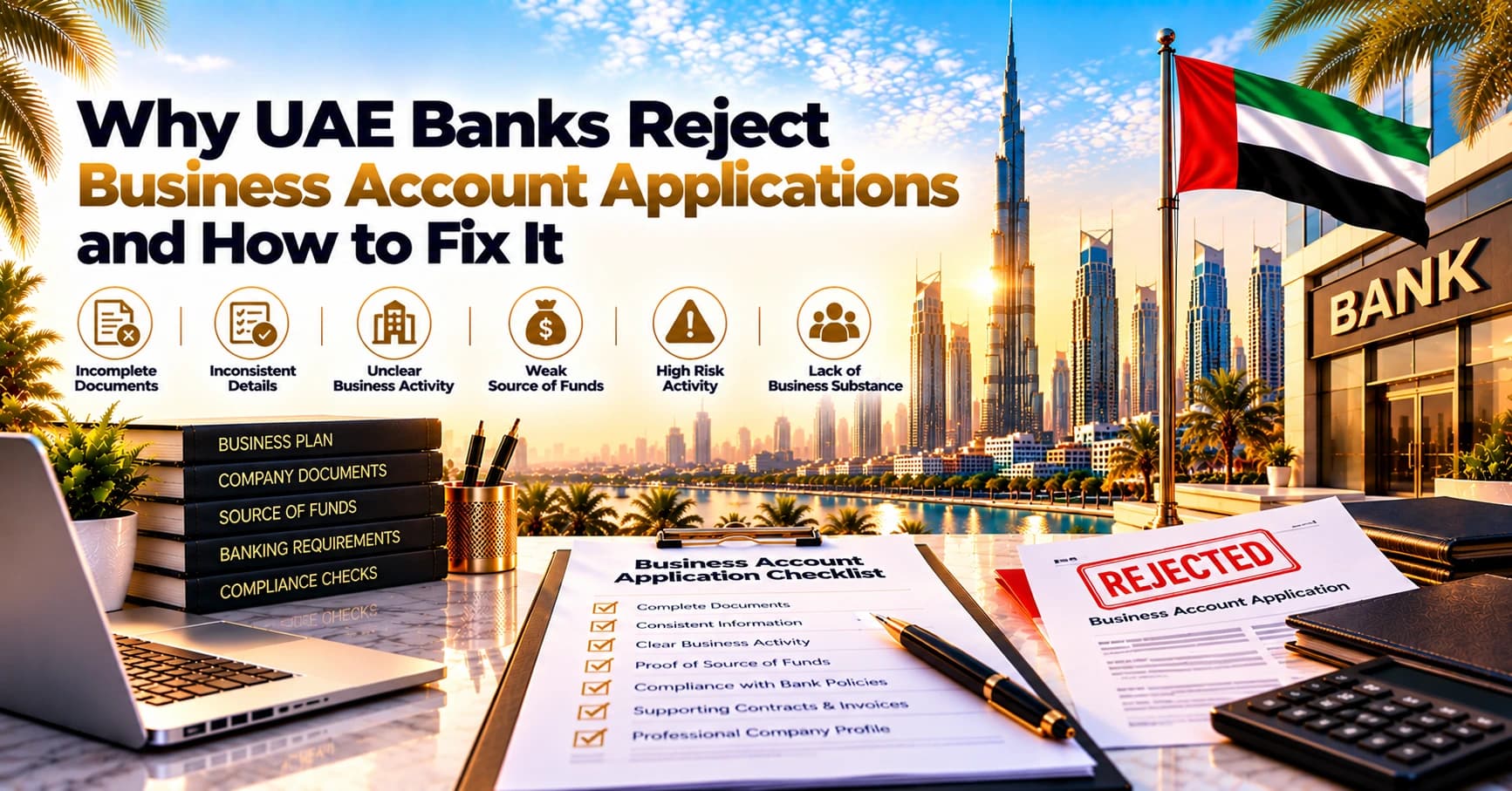
You have your trade license, your office and your visas, and then the bank says no. A rejected business account application is one of the most frustrating moments for new founders in the UAE, because you cannot receive customer payments, pay suppliers or run payroll properly without an account. It can also add unplanned expenses to the cost to start a business in Dubai, since delays affect rent, salaries and sales.
At Company Setup Consultant, we work with founders who have been declined and help them rebuild their applications. Here is a quick summary of the most common reasons.
Rejection Reason | What the Bank Sees | How to Reduce the Risk |
|---|---|---|
Incomplete documents | Missing or expired paperwork | Prepare a full checklist before applying |
Inconsistent details | Names or addresses that do not match | Align every document before submission |
Unclear business activity | Vague description of what the company does | Provide a clear company profile |
Weak source of funds | Capital with no supporting evidence | Attach statements and proof of income |
High risk activity or country | Business linked to higher risk sectors | Explain compliance controls and clients |
Lack of substance | No real office, staff or operations | Show contracts, invoices and premises |
Poor banking history | Previous negative records | Resolve issues and disclose accurately |
UAE banks most often reject business account applications because of incomplete or inconsistent documents, unclear business activity, weak evidence of source of funds, high risk sectors, lack of real business substance or negative compliance findings. Banks are not always required to explain their decision, so a well prepared and consistent file is the best protection.
Why UAE Banks Are So Strict
UAE banks operate under strict anti money laundering, counter terrorism financing and sanctions rules set by the regulators. Every bank must know who owns and controls each customer, what the company really does and where the money comes from. If a bank cannot verify these points with confidence, it may decline the application to avoid regulatory risk.
This means a rejection is often about the bank's risk assessment, not a judgement on your business idea.
The Most Common Reasons for Rejection
1. Incomplete or Inconsistent Documents
Missing pages, expired IDs, unsigned forms or unclear scans can stop a file quickly. Even small mismatches, such as different spellings of a name or a different address on the license and tenancy contract, can raise flags. Our guide on documents required for a business bank account in the UAE gives you a full checklist to prepare before you apply.
2. Unclear Business Activity
If the bank cannot understand what you sell, who your customers are and how you earn revenue, it may consider the risk too high. Descriptions like "general services" or "trading" without detail rarely help. Provide a clear profile, sample contracts and a short explanation of your business model.
3. Weak Source of Funds or Wealth
Banks want to know where your capital came from. If you cannot show credible evidence, such as savings, salary history, previous business profits or sale proceeds, the application may be declined.
4. High Risk Activities or Jurisdictions
Some sectors are treated as higher risk because of their exposure to cash, cross border payments or sanctions. Examples can include certain types of trading, crypto related services, money exchange, precious metals and businesses with links to high risk countries. Each bank sets its own appetite, so an activity that one bank rejects may be acceptable to another with the right controls.
5. Lack of Business Substance
Banks may reject companies that appear to exist only on paper. Signs include no real office, no staff, no website, no customers and no supplier relationships. This is especially relevant for non resident owners and virtual setups. Your choice of office or desk matters here, so read our article on the office requirement for a trade license in the UAE to understand how your address can support your banking application.
6. Complex Ownership Structures
Layered ownership involving multiple holding companies, trusts or offshore entities can slow down or block approval because the bank must identify the ultimate beneficial owners. Provide clear structure charts and supporting documents.
7. Negative Banking or Compliance History
Adverse media, sanctions matches, unpaid loans or previous account closures can lead to automatic rejection. Be honest in your disclosures, because hidden issues discovered later are worse than issues explained upfront.
8. Unrealistic Projections and Transaction Profile
If your expected turnover, transaction sizes or countries of operation do not match your business type, the bank may see a mismatch. Build realistic projections that align with your industry.
9. Poor Communication During Review
Banks often send follow up questions. Slow, incomplete or inconsistent answers can cause the file to be closed. Assign one person to handle bank queries quickly.
10. Choosing the Wrong Bank
Banks differ in their minimum balance, target customers and risk appetite. Applying to a bank that does not serve your company type is a common reason for rejection. Founders who want a clear picture of the options can compare choices in our guide on how to start a business in Dubai, which explains how banking fits into the full setup journey.
Tax and Compliance Status Can Also Matter
Banks may check whether your company has the right tax registrations and files its returns on time. Missing VAT or corporate tax obligations can raise concerns, especially for operating companies. Understanding your obligations early helps, so review our guides on how to file a VAT return in the UAE and corporate tax for free zone companies. Tax rules change regularly, so confirm your position with the Federal Tax Authority or a qualified adviser.
What to Do After a Rejection
Ask for feedback. Banks do not always explain, but a relationship manager may give hints about missing items.
Review your file. Check every document for consistency, validity and completeness.
Strengthen your story. Add a clearer company profile, contracts, invoices and evidence of source of funds.
Fix structural issues. Address gaps such as address, substance or ownership clarity.
Choose a better fit bank. Match your activity and profile to the right institution.
Reapply carefully. Avoid submitting many applications at once without fixing the underlying issues.
Consider alternatives. Some companies use digital or specialised accounts while their traditional application is reviewed.
How Rejection Affects the Cost to Start a Business in Dubai
A delayed bank account can create hidden expenses that many founders overlook. The cost to start a business in Dubai should include not only the license and visas but also buffer costs such as:
Office or desk rent during the waiting period
Salaries and visa costs before revenue starts
Repeated application or documentation fees
Attestation, translation and courier expenses
Consultant or PRO support for resubmissions
Minimum balance requirements once approved
Bank terms and fees differ by institution and change over time, so treat any figure you find online as indicative and confirm current terms directly.
How to Prepare for Approval From the Start
Choose a clear business activity and describe it consistently
Keep names, addresses and dates identical across all documents
Prepare source of funds evidence before you apply
Show real substance with a workable office, contracts and a website
Build a realistic transaction profile
Respond promptly to every bank request
Work with an adviser who understands current bank expectations
Why Work With Company Setup Consultant
Company Setup Consultant helps founders prepare bank applications that are complete, consistent and matched to the right bank. We review your documents, spot weak points before submission and guide you through follow up questions. If your application was declined, we help you understand the likely causes and plan a stronger resubmission. Our advice reflects current banking practice and focuses on long term relationships, not shortcuts.
Frequently Asked Questions
Q: Why do UAE banks reject business account applications?
A: Common reasons include incomplete or inconsistent documents, unclear business activity, weak source of funds evidence, high risk sectors, lack of business substance and negative compliance findings.
Q: Will the bank tell me why my application was rejected?
A: Not always. Banks are often not required to give detailed reasons, so reviewing your file and getting expert feedback is important.
Q: Can I reapply after a rejection?
A: Yes. You can reapply after fixing the likely issues or apply to a different bank that better matches your profile.
Q: Does a rejection affect my chances with other banks?
A: Not automatically, but repeated applications with the same weaknesses can lead to repeated rejections. Improve your file before applying again.
Q: Are non resident owners more likely to be rejected?
A: They may face extra checks, especially for source of funds and business substance, but many are approved with strong documentation.
Q: Do I need an office to avoid rejection?
A: A registered address is required, and real operating substance improves your chances. Requirements depend on the bank and your license type.
Q: Can I run my business without a bank account?
A: It is very difficult. A corporate account is needed for payments, payroll and compliance, so resolving the issue quickly is important.
Need Help Getting Your Bank Account Approved?
A rejection is not the end of the road, but it is a signal to strengthen your application before you try again. Company Setup Consultant will review your file, identify the gaps and guide you to the banking option that fits your business, with clear and upfront pricing. Our team handles the preparation, follow ups and coordination so you can start trading with confidence. Contact Company Setup Consultant.