
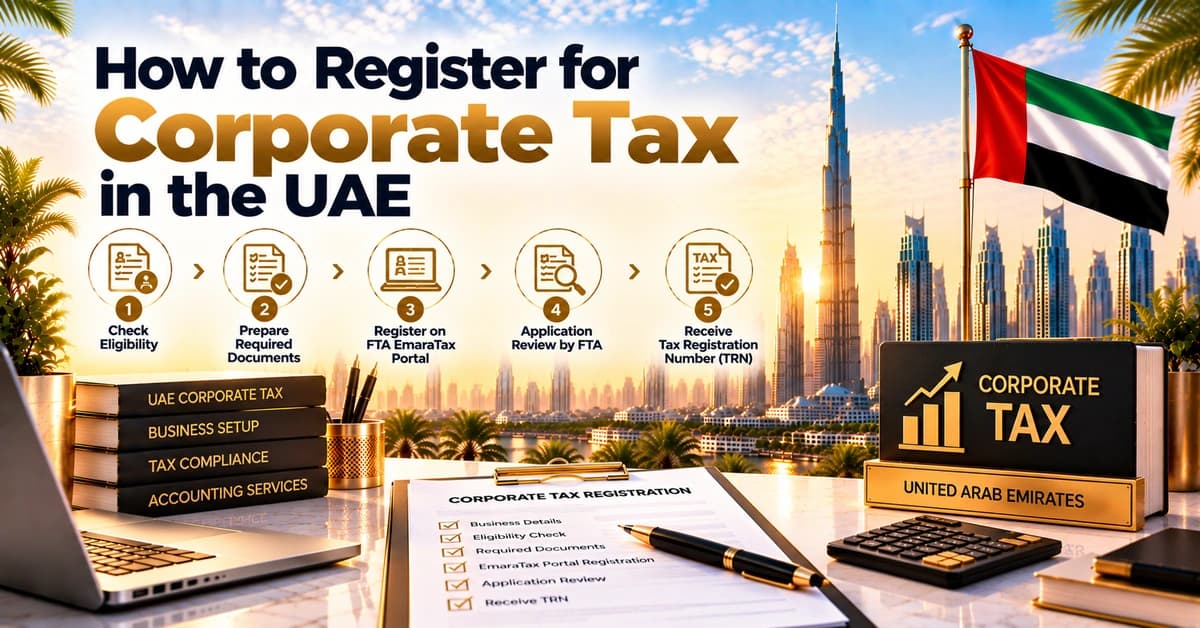
If you own a company in Dubai or plan to start one, corporate tax registration is now part of running a legal business in the UAE. Many founders focus only on licensing and visas, then discover that tax compliance adds time and cost to their plans. Understanding this early helps you budget properly and avoid penalties.
At Company Setup Consultant, we help investors and entrepreneurs set up and stay compliant in Dubai and across the UAE. This guide explains who must register, what you need, how the process works on the Federal Tax Authority portal, and how it affects the overall cost to start a business in Dubai.
What Is Corporate Tax in the UAE?
Corporate tax is a direct tax on the net income or profit of companies and certain individuals doing business in the UAE. The federal corporate tax regime applies to financial years starting on or after 1 June 2023.
The key rates are simple:
0% on taxable income up to AED 375,000
9% on taxable income above AED 375,000
A separate regime applies to certain large multinational groups
The Federal Tax Authority (FTA) administers the tax and runs the registration system through its EmaraTax portal.
Who Must Register for Corporate Tax?
Registration is not optional for most business owners. Under UAE rules, even a company with zero taxable income generally needs to register. The table below gives a quick overview.
Business Type | Registration Required? | Key Point |
|---|---|---|
UAE mainland company | Yes | Applies to all licensed juridical persons |
Free zone company | Yes | May get 0% on qualifying income if conditions are met |
Foreign company with permanent establishment or effective management in the UAE | Yes | Depends on activity and presence in the UAE |
Freelancer or sole proprietor with turnover above AED 1 million per calendar year | Yes | Turnover threshold decides registration |
Freelancer or sole proprietor with turnover below AED 1 million | Generally no | Keep records and monitor turnover |
Free zone owners should not assume they are exempt. A free zone company must still register, and it only benefits from the 0% rate if it meets the conditions of a Qualifying Free Zone Person. You can read more about this in our guide on free zone corporate tax in the UAE.
Why Corporate Tax Registration Matters for Your Business
Registration gives your company a Corporate Tax Registration Number and puts you on the FTA's system. It matters for four practical reasons:
Legal compliance. Operating without registering can lead to administrative penalties.
Banking and due diligence. Banks, investors and partners increasingly ask for proof of tax registration.
Access to reliefs. You can only claim benefits such as small business relief or free zone treatment if you are properly registered and file correctly.
Business credibility. A compliant company is easier to finance, sell and scale.
Documents Required for Corporate Tax Registration
Preparing documents in advance saves days of back and forth. Typically, you will need:
A valid trade license
Memorandum of Association or other incorporation documents
Passport copies and Emirates ID of owners, partners and shareholders
Details and proof of authority of the authorised signatory
Contact details such as a registered email and mobile number
Your financial year end and other company details
Many of these overlap with the paperwork used when you first incorporate. If you want to see what you should already have on file from your initial setup, our overview of the documents required for business setup in the UAE is a helpful reference.
Step by Step Process to Register for Corporate Tax in the UAE
Step 1: Create an EmaraTax Account
Go to the FTA's EmaraTax portal and sign up using a valid email address. If you already have an account for another tax service, you can use the same login.
Step 2: Add Your Taxable Person Details
Choose to add a new taxable person and select the Corporate Tax option. Enter your legal entity information exactly as it appears on your trade license.
Step 3: Enter Business and Ownership Information
Provide details about your legal structure, licensing authority, license number, ownership and activities. Accuracy here is critical because mismatches with your license can delay approval.
Step 4: Add Authorised Signatory Details
Enter the person who is legally authorised to act for the company and upload supporting documents.
Step 5: Review, Declare and Submit
Check every field, confirm the declaration and submit. The FTA reviews your application and, once approved, issues your corporate tax registration and Tax Registration Number.
Step 6: Keep Records and Set Reminders
After approval, note your first tax period, your financial year end and your filing deadlines. Registration is the beginning of an ongoing compliance cycle, not a one time task.
Corporate Tax Registration Deadlines
Deadlines depend on the type of taxable person and, for many companies, on when the license was issued. FTA guidance has set staggered dates for existing businesses. For newly incorporated companies, the rule of thumb is to register within a set number of months from incorporation. Because these timelines have been updated by the authorities over time, always confirm the current deadline for your entity type on the official FTA website or with a qualified adviser before you file.
Filing rules after registration are more straightforward. The corporate tax return is generally due within nine months from the end of your tax period. A company with a 31 December year end would therefore file by 30 September of the following year. Our detailed walkthrough on corporate tax return filing in the UAE covers this stage.
Penalties for Late or Missed Registration
The UAE takes non registration seriously. A failure to register for corporate tax within the required time can attract an administrative penalty of AED 10,000. Additional penalties may apply for late filing, late payment and record keeping failures.
For a new or growing business, an avoidable fine hurts cash flow more than it seems. The safest approach is to treat tax registration as part of your launch checklist, not an afterthought.
Does Small Business Relief Apply to You?
Small business relief allows eligible businesses to be treated as having no taxable income for a tax period. In broad terms, it is available to resident persons whose revenue does not exceed AED 3 million, and it applies for tax periods ending on or before 31 December 2026. Some entities, such as members of large multinational groups and Qualifying Free Zone Persons, are excluded.
Important points to remember:
You still need to register and file a return even if you use the relief
Eligibility is assessed for each tax period
The relief is time limited, so future planning is essential
If you run a smaller operation and want to understand your position, read our article on UAE corporate tax for small businesses.
How Corporate Tax Affects the Cost to Start a Business in Dubai
Many people search for the cost to start a business in Dubai and expect a single number. In reality, the total depends on your activity, license type, office needs, visas and ongoing compliance. Corporate tax adds a compliance layer that should be part of your budget.
When you compare the cost of starting a business in Dubai across mainland and free zone options, include these recurring items. To build a realistic budget from day one, see our breakdown of the cost to start a business in Dubai.
Common Mistakes to Avoid When Registering
We see the same errors repeatedly among new business owners:
Assuming a free zone company does not need to register
Entering company details that do not match the trade license
Missing the registration window because the license was issued earlier than expected
Ignoring registration because the company has no profit yet
Using the wrong authorised signatory or missing proof of authority
Not keeping records that support the figures in the return
Avoiding these mistakes keeps your application smooth and your compliance record clean.
Why Work With Company Setup Consultant?
Registering for corporate tax is manageable, but it sits alongside licensing, visas, banking and accounting. Getting one piece wrong can slow everything else. Company Setup Consultant supports businesses through the full journey, from choosing the right jurisdiction to staying compliant after launch. Our team explains rules in plain language, prepares your documents, and coordinates the process so you can focus on running the business. You can explore our business support services in Dubai to see how we handle accounting, compliance and ongoing needs.
Frequently Asked Questions
Q: Is corporate tax registration mandatory in the UAE?
A: Yes. Most UAE mainland companies, free zone companies and certain individuals with turnover above AED 1 million must register with the Federal Tax Authority, even if they expect to pay no tax.
Q: How do I register for corporate tax in Dubai?
A: You register online through the FTA's EmaraTax portal. Create an account, add your taxable person details, upload documents such as your trade license and signatory proof, then review and submit.
Q: Do free zone companies need to register for corporate tax?
A: Yes. Free zone companies must register, but they may benefit from a 0% rate on qualifying income if they meet the Qualifying Free Zone Person conditions.
Q: What is the corporate tax rate in the UAE?
A: The rate is 0% on taxable income up to AED 375,000 and 9% on taxable income above that amount, with a separate regime for certain large multinational groups.
Q: What is the penalty for not registering for corporate tax on time?
A: A failure to register within the required period can result in an administrative penalty of AED 10,000.
Q: How much does it cost to register for corporate tax?
A: There is no government fee to register on the FTA portal. Costs usually come from professional support, accounting and return preparation, which should be included in your overall cost to start a business in Dubai.
Q: Do I need to register if my business has no income yet?
A: In most cases, yes. Registration depends on your legal status and license, not on whether you have generated profit.
Q: Can I claim small business relief without registering?
A: No. You must be registered and file your return to claim the relief, provided you meet the eligibility conditions.
Get Corporate Tax Registration Right With Company Setup Consultant
Starting a business in Dubai should feel exciting, not confusing. Company Setup Consultant helps you plan your setup, understand your costs and complete corporate tax registration correctly the first time. Speak to our experts for a clear, no pressure consultation tailored to your business. Contact us today and let us handle the paperwork while you focus on growth.