
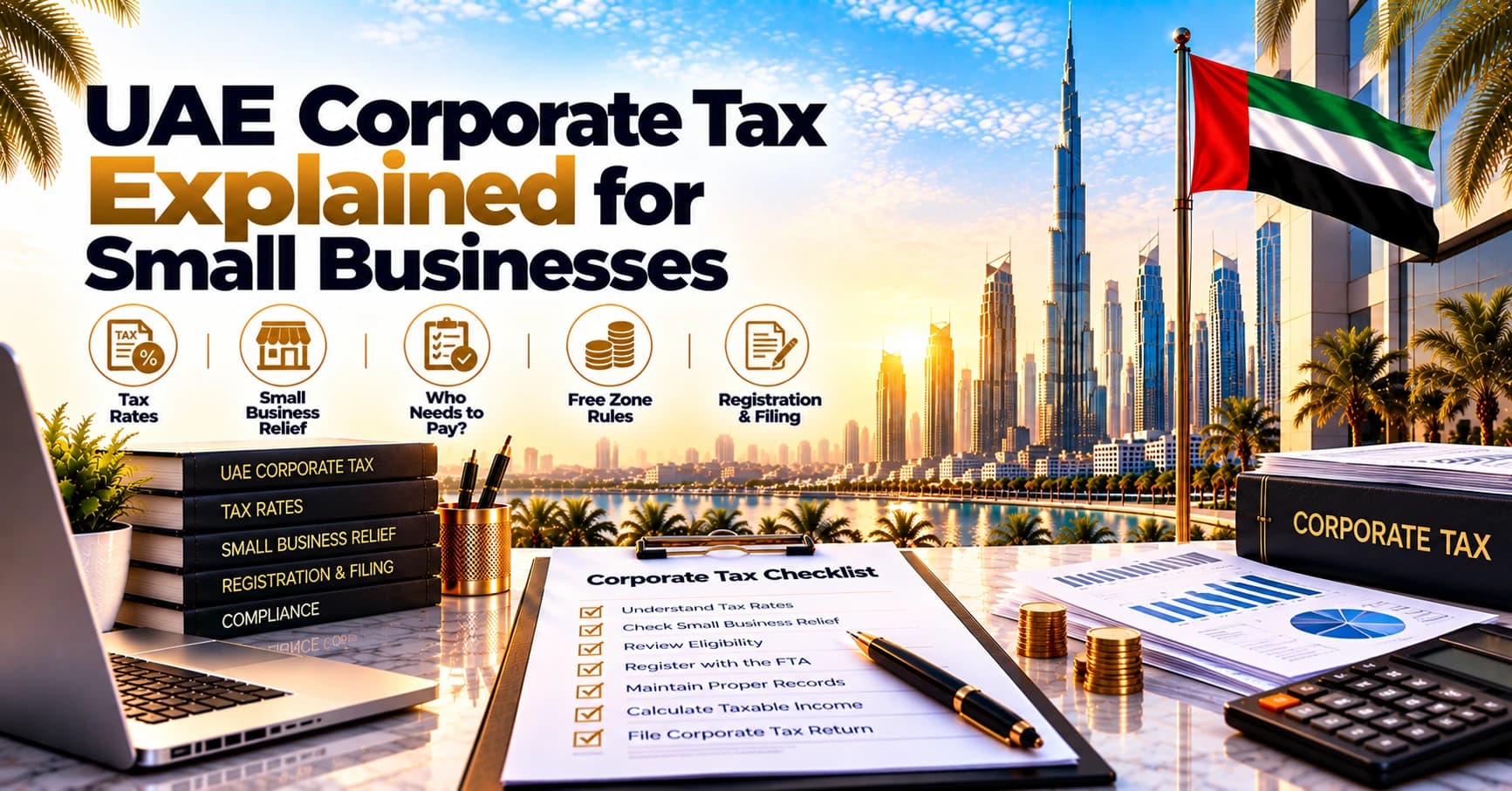
At Company Setup Consultant, we explain corporate tax to founders in plain language. Here is what small businesses need to know.
UAE corporate tax applies at 0 percent on taxable income up to AED 375,000 and 9 percent on taxable income above that amount, for most businesses. Eligible small businesses with revenue of AED 3 million or less can elect Small Business Relief and be treated as having no taxable income. Even when no tax is payable, most businesses still need to register and file a return.
The Basic Corporate Tax Rates
Taxable Income | Rate |
|---|---|
Up to AED 375,000 | 0 percent |
Above AED 375,000 | 9 percent |
Qualifying free zone income (for qualifying persons) | 0 percent |
Large multinational groups meeting the global minimum tax rules | Different rules may apply |
Corporate tax is charged on taxable income, which is your accounting profit adjusted for specific tax rules. It is not charged on revenue. A business that earns AED 2 million in revenue but has substantial deductible costs may have a much smaller taxable income.
Who Has to Pay UAE Corporate Tax?
Corporate tax applies to:
UAE companies and other legal entities, including mainland and most free zone companies
Foreign companies with a permanent establishment or place of effective management in the UAE
Individuals conducting a business or business activity in the UAE, if their turnover passes the prescribed threshold
Salaried employment income, personal investment income and certain other personal income are generally outside the scope. Because scope rules are technical, check your position with the Federal Tax Authority (FTA) or a qualified adviser.
What Is Small Business Relief?
Small Business Relief allows an eligible resident business to elect to be treated as having no taxable income for a tax period, which means no corporate tax is payable. The key features are:
Revenue must not exceed AED 3 million in the relevant tax period
The business must be a resident taxable person
Certain businesses are excluded, including qualifying free zone persons and members of large multinational groups
You must actively elect the relief in your corporate tax return, as it is not automatic
Registration and filing obligations still apply
A point many owners miss is that the AED 3 million figure is not a tax free allowance. It is a condition for choosing the relief. Once revenue passes it for a period, the relief no longer applies for that period.
Is Small Business Relief Still Available?
This is where outdated articles cause confusion. The relief was originally scheduled to apply only to tax periods ending on or before 31 December 2026, and many older guides still say it will end then. However, the Ministry of Finance announced on 7 August 2026 that Ministerial Decision No. 131 of 2026 extends the window for electing Small Business Relief to tax periods ending on or before 31 December 2029. The AED 3 million revenue threshold and the other existing eligibility conditions remain unchanged. corporatetaxuaereina-consulting
Rules like these can be amended again, so always confirm the current position with the FTA or your tax adviser before you rely on it.
Do Small Businesses Still Need to Register for Corporate Tax?
Yes. In general, taxable persons must register with the FTA, even if their income is below the 0 percent band or they plan to elect Small Business Relief. Registration deadlines were set in stages based on when a license was issued for existing businesses, and new companies are expected to register within the timeframe set by the FTA. Our step by step guide on how to register for corporate tax in the UAE explains the process and the documents you will need.
Corporate Tax and Free Zone Companies
Free zone companies are not automatically exempt. A free zone business may qualify for a 0 percent rate on qualifying income if it meets specific conditions, such as having adequate substance in the UAE and meeting the rules on qualifying activities. Income that does not qualify may be taxed at 9 percent, and failing the conditions can mean losing the special treatment altogether. Small Business Relief is generally not available to qualifying free zone persons, so choosing between routes matters. Read more in our guide on corporate tax for free zone companies.
Filing Your Corporate Tax Return
Registered businesses must file a return for each tax period, generally within nine months after the end of the financial year, and pay any tax due by the same deadline. Financial statements and supporting records form the base of the return. If you are electing Small Business Relief, you make that election in the return itself. For a walk through of the filing process, see our guide on corporate tax return filing in the UAE.
Records You Should Keep
Good record keeping is a compliance requirement, not just good practice. Keep:
Sales invoices and purchase invoices
Bank statements and payment records
Payroll and contract records
Fixed asset and loan records
Financial statements for each period
Documents supporting related party transactions
Records generally need to be kept for several years after the tax period ends, so confirm the exact period with the FTA.
Penalties You Should Avoid
The FTA applies administrative penalties for issues such as failing to register on time, filing late or keeping inadequate records. Amounts and conditions are set by law and can change, so verify the current schedule. Our overview of corporate tax penalties in the UAE explains the most common triggers so you can avoid them.
How Corporate Tax Interacts With VAT
Corporate tax and VAT are separate taxes with separate thresholds, registrations and returns. VAT is a 5 percent tax on supplies, while corporate tax is charged on profits. Being below the corporate tax band does not mean you avoid VAT, and vice versa. To understand the VAT side, read our guide to the VAT registration threshold in the UAE.
A Simple Example
Imagine a consulting company with AED 1.2 million in revenue and AED 700,000 in allowable costs, leaving AED 500,000 of taxable income. Without any relief, the first AED 375,000 would be taxed at 0 percent and the remaining AED 125,000 at 9 percent, which is AED 11,250. If the business is eligible and elects Small Business Relief, it would be treated as having no taxable income for that period, so no corporate tax would be payable, although it would still file its return. This example is illustrative only and does not replace advice on your actual figures.
How Corporate Tax Affects the Cost to Start a Business in Dubai
Tax used to be a minor line in a Dubai budget. Today, the cost to start a business in Dubai should include:
License, office and visa costs
Accounting and bookkeeping
Corporate tax registration and annual return
VAT registration and filing, where applicable
Possible tax payments once profits pass the 0 percent band
Professional fees for review or advice
Pricing for accounting and tax services differs between providers, so request a clear quotation. If you would rather hand off accounting, tax filing and other admin, our business support services in Dubai can manage them for you.
Common Mistakes Small Businesses Make
Assuming no registration is needed because the income is low
Treating the AED 3 million figure as a tax free allowance
Forgetting to elect Small Business Relief in the return
Relying on old articles that say the relief has ended
Mixing personal and business finances
Filing late because records were not kept up to date
Why Work With Company Setup Consultant
Company Setup Consultant helps small businesses understand their corporate tax position, register on time and stay compliant year after year. We explain the rules in clear language, check your eligibility for reliefs and coordinate with accountants so your filings are accurate. Our guidance follows current FTA information and focuses on avoiding penalties before they happen.
Frequently Asked Questions
Q: What is the corporate tax rate for small businesses in the UAE?
A: Taxable income up to AED 375,000 is taxed at 0 percent and income above that is taxed at 9 percent for most businesses. Eligible small businesses can also elect Small Business Relief.
Q: Who qualifies for Small Business Relief?
A: Resident businesses with revenue of AED 3 million or less in the tax period, which are not excluded categories such as qualifying free zone persons or members of large multinational groups.
Q: Is Small Business Relief automatic?
A: No. You must elect it in your corporate tax return for each eligible period.
Q: Do I need to register for corporate tax if I earn very little?
A: Generally yes. Most taxable persons must register and file returns even when no tax is payable.
Q: Do free zone companies pay corporate tax?
A: It depends. Qualifying free zone persons may get 0 percent on qualifying income if they meet the conditions, while other income may be taxed at 9 percent.
Q: When is the corporate tax return due?
A: Generally within nine months after the end of the tax period. Confirm your exact deadline in your FTA account.
Q: What happens if I miss the deadline?
A: You may face administrative penalties. Filing as soon as possible and seeking advice is better than waiting.
Need Help With Corporate Tax for Your Small Business?
Corporate tax does not have to be complicated when you have the right guidance from the start. Company Setup Consultant will review your structure, check your eligibility for Small Business Relief and guide you through registration and filing with clear and upfront pricing. Our team handles the paperwork and follow ups so you can focus on growing your business.