
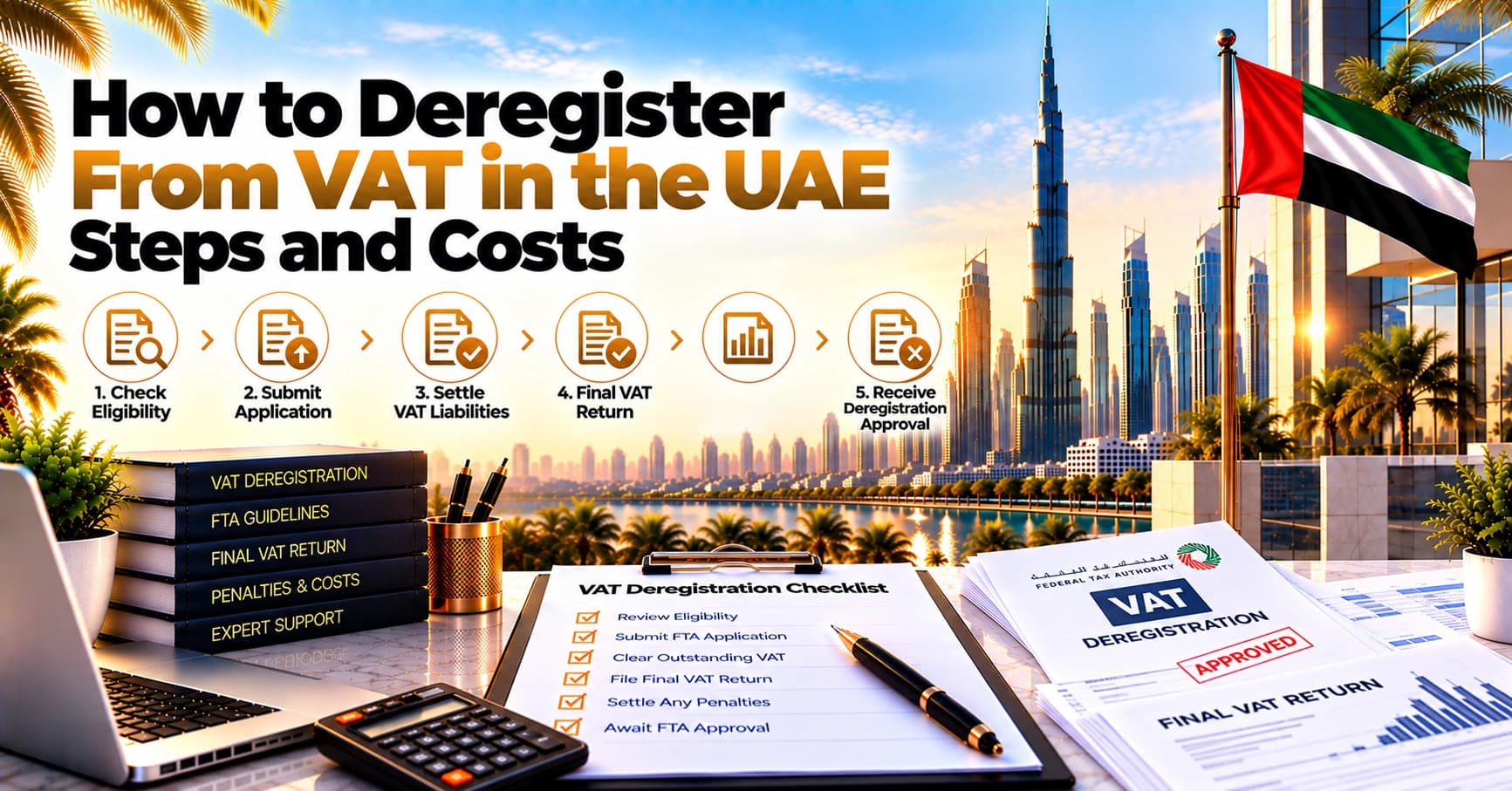
Registering for VAT is a routine step for many UAE businesses, but closing that registration properly is just as important. If your company stops trading, drops below the required turnover, or is closing down, you may need to deregister from VAT. Leaving your registration open by mistake can lead to penalties and continued filing duties, which quietly adds to the true cost to start a business in Dubai and to keep it running.
At Company Setup Consultant, we help business owners register, file, and deregister for VAT in line with Federal Tax Authority rules. The table below shows the two main routes to VAT deregistration, so you can see which one applies to your business before you start.
Route | When It Applies | Key Condition | Timing |
|---|---|---|---|
Mandatory deregistration | The business stops making taxable supplies or ceases to operate | No longer carrying out taxable activity | Application must be made within the deadline set by the FTA |
Voluntary deregistration | The business is registered but no longer needs to be | Taxable supplies and expenses fall below the voluntary threshold and are expected to stay below it | Can be requested when eligible |
Deregistration on company closure | The company is being liquidated or cancelled | Final returns filed and liabilities settled | Usually before or alongside license cancellation |
Change in legal structure | Business is transferred or merged | Registration may move to another entity | Handled case by case with the FTA |
Thresholds, deadlines, and penalties can change, so always confirm the current position with the Federal Tax Authority before you act.
What Is VAT Deregistration?
VAT deregistration is the formal process of cancelling your business's VAT registration with the Federal Tax Authority. Once approved, you stop charging VAT on your sales, stop filing regular VAT returns, and lose the right to reclaim VAT on your purchases from the effective date of deregistration.
It is not the same as closing your trade license. Your license and your tax registration are separate records held by separate authorities. A company can hold a valid license and no VAT registration, or the reverse. When a business winds down, both need to be closed correctly and in the right order.
Who Needs to Deregister From VAT?
You may need to deregister if your business:
Has stopped making taxable supplies and does not expect to resume
Is closing down, being liquidated, or cancelling its trade license
Has been sold, merged, or restructured, so the registered entity no longer operates
Was registered, but its turnover and expenses have stayed below the voluntary registration limit
Registered by mistake or no longer meets the conditions for registration
The UAE VAT rules set a mandatory registration threshold of AED 375,000 in taxable supplies over 12 months, and a voluntary threshold of AED 187,500 for supplies or expenses. Understanding these limits helps you decide whether you must stay registered or can leave. Our guide on the VAT registration threshold in the UAE explains how the limits work and how they are calculated.
Mandatory vs Voluntary VAT Deregistration
Mandatory deregistration. If your business no longer makes taxable supplies, or you stop the activity that required registration, you are generally required to apply for deregistration within a set period. Missing the deadline can lead to administrative penalties.
Voluntary deregistration. If your business is still active but your taxable supplies and expenses in the past 12 months were below the voluntary threshold, and you expect them to remain below it, you may apply to deregister. The FTA will assess whether you meet the conditions, and they may ask for supporting records.
Choosing the wrong route can lead to rejection, so check which category you fall under before you submit.
How VAT Deregistration Affects the Cost to Start a Business in Dubai
VAT is often treated as a one time registration task, but it is really a lifecycle. When you estimate the cost to start a business in Dubai and to operate it over time, think about these VAT related items:
Registration and setup costs at the start
Accounting and bookkeeping fees to prepare VAT returns each period
Professional fees for deregistration and final filings
Possible penalties for late filing, late payment, or late deregistration
Cash flow impact of paying any final VAT due
Record keeping costs, since documents must be retained for several years after you leave the system
Exiting properly keeps these costs predictable. Ignoring the process often results in avoidable fines that exceed the fee of doing it right. Where you are unsure about your position, a short review with a tax professional is usually cheaper than a penalty.
Documents Usually Required
Requirements depend on your case, but you should generally prepare:
Tax registration number and FTA portal login details
Trade license copy and, if closing, proof of closure or cancellation progress
Emirates ID and passport copies of the owner or authorized signatory
Final VAT return for the last tax period, or a plan to file it
Financial statements or turnover records for the past 12 months
Details of assets held, and VAT position on those assets
Supporting evidence of why deregistration is requested, such as cessation of business or turnover below the limit
Bank statements and invoices, where the FTA asks for proof
Keep your records organized, because inconsistencies between your returns and your supporting documents can delay approval.
Step by Step: How to Deregister From VAT in the UAE
Confirm your reason. Decide whether you are applying under mandatory or voluntary rules, or because of a company closure.
Review your position. Check turnover, expenses, assets, and any outstanding VAT due or refunds claimed.
File all pending returns. Make sure every VAT return up to the date of application is submitted and correct.
Settle liabilities. Pay any VAT, penalties, or adjustments that are due.
Log in to the FTA portal. Use the business's tax account to open the deregistration application.
Complete the form. Enter the reason, effective date, and required details accurately.
Upload supporting documents. Attach proof of cessation, turnover records, and other requested files.
Submit and track the application. The FTA may ask for clarifications, so monitor your account and respond quickly.
File the final return. After approval, submit the final VAT return covering the last period and pay any balance.
Keep your records. Store invoices, returns, and accounting files for the required retention period.
Processing time varies by case, and complex files can take longer if the FTA requests more information.
What Happens After Deregistration?
Once your deregistration is approved, you must stop charging VAT from the effective date and stop claiming input VAT on new purchases. You are also required to file a final return covering the period up to that date, and you may need to account for VAT on assets still held by the business, depending on the rules that apply.
Do not treat approval as the end of your obligations. Records must still be kept, and the FTA can review earlier periods. If errors are found, you may need to correct them and pay any difference.
VAT Deregistration and Company Closure
If you are closing your company, the order of steps matters. Tax deregistration, visa cancellations, bank account closure, and license cancellation each depend on the others. Doing them out of sequence is a common reason for blocked applications.
In most closures, you should clear your tax position, including VAT, before finalizing the license cancellation. Our guide on closing a company in the UAE through liquidation explains how the full closure process fits together, including approvals and final clearances.
Do Not Forget Corporate Tax
VAT and corporate tax are separate regimes. Deregistering from VAT does not close your corporate tax registration, and the reverse is also true. If your company is registered for corporate tax, you will need to handle that deregistration on its own timeline and file any final returns. Our guide on corporate tax deregistration in the UAE explains when and how to close that registration correctly.
Penalties and Common Mistakes
Missing the deadline. Failing to apply for deregistration within the required period can trigger administrative penalties.
Skipping final returns. An unfiled return keeps your account open and can lead to fines.
Ignoring assets. VAT may apply to certain assets still owned when you leave the system.
Closing the license first. If the license is cancelled before VAT is dealt with, you may face problems accessing your tax account or resolving penalties.
Using inconsistent records. Differences between your returns, invoices, and bank statements can delay approval.
Assuming inactivity means no duty. A dormant company can still have filing obligations until deregistration is approved.
Penalty amounts and rules are updated from time to time. To understand how tax penalties work more generally, read our guide on corporate tax penalties in the UAE, and always confirm the current VAT penalty schedule with the FTA.
When to Get Professional Help
You may want expert support if:
You have unfiled returns or unpaid VAT
You hold significant assets or stock at the time of exit
Your turnover is close to the threshold and the correct route is unclear
You are closing several entities or restructuring a group
You are unsure how deregistration interacts with your license, visas, and bank account
If your last step is to file a clean final return, our guide on how to file a VAT return in the UAE walks through what to include and the deadlines to remember.
How Company Setup Consultant Can Help
VAT deregistration is a compliance task where small mistakes can create real costs. Company Setup Consultant reviews your position, confirms whether you qualify for mandatory or voluntary deregistration, prepares your documents, and coordinates the final filings with your closure or restructuring plan. Through our business support services in Dubai, we also help you stay compliant with licensing, visas, and tax registrations, and we give you a clear cost estimate before we start.
Final Thoughts
Deregistering from VAT in the UAE is straightforward when you follow the right steps in the right order, but it can become expensive if you delay or skip requirements. Confirm whether you must or may deregister, settle your returns and liabilities, and submit a complete application with supporting records. When you plan the cost to start a business in Dubai, include the cost of staying compliant and of exiting properly, not only the cost of entering the market.
Check the current thresholds, keep your records organized, and act before deadlines pass.
This article is for general information only and does not replace legal, tax, or financial advice. Thresholds, deadlines, and penalties in the UAE change often, so verify current details with the Federal Tax Authority or a qualified tax professional.
Frequently Asked Questions
Q: How do I deregister from VAT in the UAE?
A: You apply through your Federal Tax Authority account, provide the reason and effective date, upload supporting documents, and file any final return once the application is approved.
Q: When is VAT deregistration mandatory in the UAE?
A: It is generally required when a business stops making taxable supplies or ceases the activity that required registration. The application must be made within the deadline set by the FTA.
Q: Can I deregister voluntarily if my turnover is low?
A: Yes, if your taxable supplies and expenses in the past 12 months were below the voluntary threshold and you expect them to stay below it, subject to FTA approval.
Q: Does VAT deregistration cancel my trade license?
A: No. Your trade license and VAT registration are separate. Closing one does not close the other, so both must be handled correctly.
Q: How does VAT deregistration affect the cost to start a business in Dubai?
A: It is part of the full cost of running and exiting a business. Correct deregistration helps you avoid penalties, extra filings, and unexpected professional fees.
Q: Do I need to file a final VAT return after deregistration?
A: Yes, in most cases you must file a final return covering the period up to the effective date and pay any balance due.
Q: What happens if I do not deregister on time?
A: You may face administrative penalties and continued filing obligations. Check the current penalty rules with the FTA.
Close Your VAT Registration the Right Way
A clean tax exit protects you from fines, blocked applications, and future compliance problems. Company Setup Consultant provides clear and transparent guidance on VAT, corporate tax, licensing, visas, and company closure, so you know exactly what to expect at every stage. Speak with our experts today for a free consultation and a customized cost estimate for your Dubai business. Contact Company Setup Consultant now and complete your VAT deregistration with confidence.