
At Company Setup Consultant, we help founders work out where they stand before deadlines catch them. This guide explains the thresholds, the exceptions and the decisions you need to make.
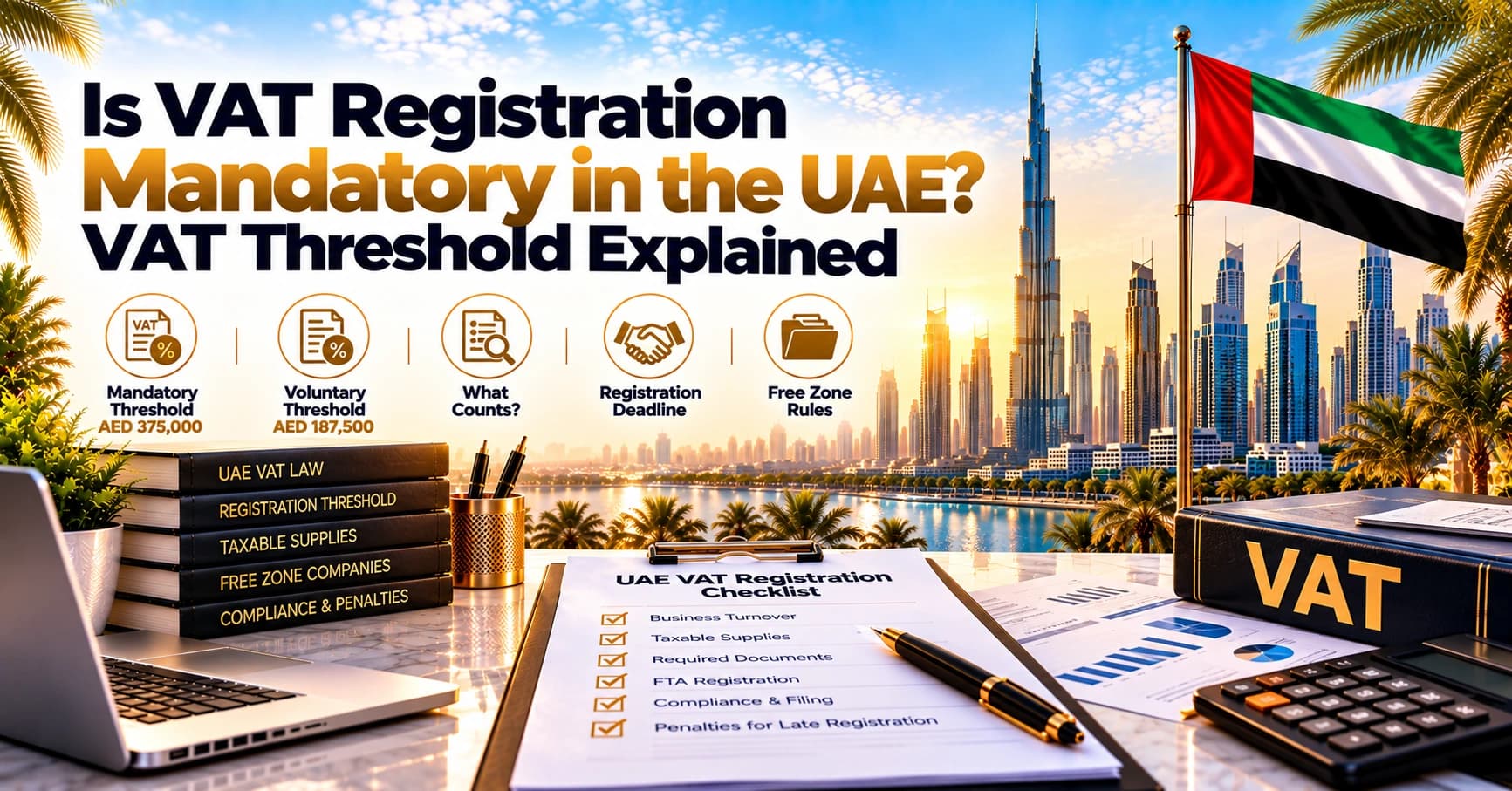
In the UAE, VAT registration is mandatory when the total value of your taxable supplies and imports exceeds AED 375,000 over the previous 12 months, or you expect it to exceed that amount in the next 30 days. Registration is optional if your taxable supplies or expenses exceed AED 187,500. Below that level, registration is generally not required. Thresholds and rules are set by law and can change, so always confirm with the Federal Tax Authority (FTA).
The Three Thresholds at a Glance
Situation | What It Means | Registration Status |
|---|---|---|
Taxable supplies and imports above AED 375,000 | Your turnover has passed the mandatory limit | Mandatory |
Supplies or expenses above AED 187,500 but below AED 375,000 | You are in the voluntary range | Optional |
Below AED 187,500 | You are under both limits | Generally not required |
Non resident business making taxable supplies in the UAE | No local threshold usually applies | Generally mandatory |
What Counts Toward the Threshold?
The threshold is based on the value of your taxable supplies and imports, not your profit. Taxable supplies include standard rated sales (at 5 percent) and zero rated sales, such as many exports. That surprises many owners: even if you charge no VAT on an export, its value still counts toward the mandatory limit.
Exempt supplies, such as certain financial services, residential property leases and local passenger transport, are generally not counted in the same way, but the rules are technical. If your business mixes taxable and exempt activities, get professional advice before you decide.
The Two Tests for Mandatory Registration
You must register if either of these is true:
The backward looking test: Your taxable supplies and imports over the previous 12 months exceeded AED 375,000.
The forward looking test: You expect your taxable supplies and imports to exceed AED 375,000 within the next 30 days.
A start up signing a large contract, for example, can trigger the forward looking test even in its first month. Track your pipeline, not just your past sales.
The Registration Deadline
Once you meet a test, the clock starts. Businesses generally have 30 days to apply. Missing this window can lead to an administrative penalty, and the FTA may also require you to account for VAT from the date you should have registered. Late registration penalties can be significant, so the safest approach is to review your turnover every month.
Voluntary VAT Registration: Should You Do It?
If your taxable supplies or expenses exceed AED 187,500 but you are below the mandatory limit, you can register voluntarily. It is worth considering when:
You pay a lot of VAT on business expenses and want to recover it
You sell mainly to VAT registered businesses that expect tax invoices
You want to look more established when bidding for larger contracts
You expect to pass the mandatory threshold soon
The trade off is compliance. Once registered, you must charge VAT on taxable sales, keep proper records and file returns on time, even if a period has no activity. If you decide to proceed, our guide on how to register for VAT in the UAE walks you through the process.
Do Free Zone Companies Have to Register?
Being in a free zone does not automatically exempt you from VAT. Whether VAT applies depends on the nature of your supplies and on whether the free zone is treated as a designated zone for VAT purposes. Goods moving between designated zones may be treated differently from services or from sales into the mainland. Because this area is technical, review your structure before you assume you are outside the system. If you are still deciding on your setup, our free zone company setup in Dubai team can explain how the model interacts with tax.
Does Your Business Activity Matter?
Yes. Your activity determines whether your supplies are standard rated, zero rated or exempt, which changes both the threshold calculation and the return you file. When you are choosing what your license should cover, keep VAT in mind. Our guide on choosing a business activity in the UAE helps you match your plans to your license and your tax profile.
Special Situations Worth Knowing
Non resident businesses: A foreign business making taxable supplies in the UAE, where no other person is required to account for the VAT under the reverse charge, may need to register regardless of turnover.
Groups of companies: Related businesses may be able to register as a tax group, which can simplify compliance but also changes how sales between members are treated.
Sole proprietors and freelancers: Individuals running a business are subject to the same thresholds, based on the total turnover of the business.
E-commerce sellers: Online sales count toward the threshold, and the place of supply rules can affect whether UAE VAT applies.
What Happens After You Register?
Registration is the start of an ongoing routine, not a one time task:
You receive a Tax Registration Number (TRN)
You must issue valid tax invoices
You must keep records for the required period
You must file returns for each tax period and pay any VAT due
Learn how the filing side works in our guide on how to file a VAT return in the UAE.
Can You Cancel VAT Registration Later?
If your turnover falls and your business no longer needs to be registered, or you stop trading, you may apply to cancel the registration. The rules depend on your circumstances, and you must keep filing until the cancellation is approved. Our article on VAT deregistration in the UAE explains the conditions and steps.
Risks of Ignoring the Threshold
Administrative penalties for late registration
Having to pay VAT out of your own pocket on sales you did not charge it on
Difficulty correcting past invoices with customers
Delays with banks, tenders or partners that check tax compliance
Extra time and cost to fix errors later
How VAT Fits Into the Cost to Start a Business in Dubai
When founders estimate the cost to start a business in Dubai, they often stop at license, office and visas. A realistic budget also includes:
Accounting software and bookkeeping
VAT registration support
Ongoing VAT filing
Corporate tax registration and filing, where applicable
Time spent on invoices and record keeping
Potential penalties if deadlines are missed
Service prices vary between providers, so ask for a clear quotation before you agree to anything.
A Simple Way to Decide
Ask yourself four questions each month:
What were my taxable supplies over the last 12 months?
What do I expect over the next 30 days?
Have my expenses passed AED 187,500?
Would registering help my customers, suppliers or cash flow?
If the answer to either of the first two questions is above AED 375,000, act quickly. If you are in the voluntary range, weigh the benefits against the added admin.
Why Work With Company Setup Consultant
Company Setup Consultant helps businesses understand their VAT position, register on time and stay compliant afterwards. We look at your activities, contracts and turnover, explain the options in plain language and coordinate the registration for you. Our advice follows current FTA guidance and focuses on avoiding penalties before they happen.
Frequently Asked Questions
Q: Is VAT registration mandatory in the UAE?
A: It is mandatory when your taxable supplies and imports exceed AED 375,000 in the previous 12 months, or you expect them to within the next 30 days.
Q: What is the voluntary VAT registration threshold?
A: You may register voluntarily if your taxable supplies or expenses exceed AED 187,500.
Q: How long do I have to register once I pass the threshold?
A: Generally 30 days. Registering late can lead to administrative penalties, so check the exact timeline with the FTA.
Q: Do exports count toward the threshold?
A: Yes. Zero rated supplies such as many exports are taxable supplies at 0 percent, and their value counts toward the threshold.
Q: Does a free zone company need to register for VAT?
A: Not automatically, but it depends on your supplies and whether the zone is a designated zone for VAT. Review your structure before deciding.
Q: Can a freelancer or sole proprietor be required to register?
A: Yes. If the turnover of the business passes the threshold, the owner must register, just like a company.
Q: What happens if I do not register on time?
A: You may face penalties and be required to account for VAT from the date you should have registered. Seek advice as soon as you realise you missed the deadline.
Not Sure If You Need to Register for VAT?
Getting your VAT position right from the start saves you penalties, stress and unnecessary paperwork. Company Setup Consultant will review your turnover, activities and plans, then confirm whether you should register now, later or voluntarily, with clear and upfront pricing. Our team handles the application and follow ups so you can stay focused on your business. Contact Company Setup Consultant today.