
Value Added Tax (VAT) is one of the first tax obligations a new UAE company needs to understand. The UAE charges VAT at a standard rate of 5% on most goods and services, and businesses that meet the criteria must register with the Federal Tax Authority (FTA), charge VAT to customers, and report it on regular returns.
Many founders plan for the license, office and visas but overlook tax compliance. That is a mistake, because accounting software, bookkeeping and filing support all add to the real cost to start a business in Dubai. At Company Setup Consultant, we help entrepreneurs plan VAT registration together with company formation, so there are no penalties or budget surprises later.
What Is VAT in the UAE?
VAT is an indirect consumption tax added at each stage of the supply chain. Businesses collect VAT from customers on taxable sales (output tax) and can usually recover the VAT they pay on business purchases (input tax). The difference is paid to, or refunded by, the FTA.
The standard VAT rate is 5%. Certain supplies are zero rated, such as some exports and international transport, and others are exempt, such as certain financial services and residential property. Understanding which category your business falls into is essential, because it affects your pricing, invoicing and returns.
Who Must Register for VAT in the UAE?
VAT registration in the UAE is based on the value of your taxable supplies and expenses. The general rules are:
Mandatory registration: if your taxable supplies and imports exceeded AED 375,000 in the previous 12 months, or are expected to exceed that amount in the next 30 days.
Voluntary registration: if your taxable supplies or expenses exceeded AED 187,500 in the previous 12 months, or are expected to exceed it in the next 30 days.
Exceptions: some businesses that only make zero rated or exempt supplies may have different treatment.
Registration is done at the level of the legal entity, not the individual location. If you are unsure whether your turnover puts you above the limit, our detailed guide on the VAT registration threshold in the UAE explains how to calculate it correctly.
Should a New Company Register for VAT Voluntarily?
Even below the mandatory limit, voluntary registration can make sense. It allows you to recover VAT on start-up costs such as equipment, rent and professional fees, and it can make your business look more established to larger clients who prefer to deal with VAT-registered suppliers.
The trade-off is added responsibility. Once registered, you must issue compliant tax invoices, keep records, file returns on time and pay any VAT due. A business with very low sales and mostly non-recoverable costs may decide to wait. The right choice depends on your customers, expenses and growth plans.
How VAT Affects the Cost to Start a Business in Dubai
VAT registration itself does not carry a large government fee, but it creates ongoing compliance costs that should be part of your budget. When you estimate the business setup cost in Dubai, consider the following:
VAT Related Cost | What It Covers | Indicative Range (AED) |
|---|---|---|
FTA registration fee | Government fee for registering | No standard fee in most cases |
Accounting software | Invoicing and VAT-ready bookkeeping | 500 to 5,000 per year |
Bookkeeping and VAT return filing | Monthly or quarterly professional support | 300 to 2,000 per filing period |
Tax consultant or agent fee | Assistance with registration | Varies by provider |
Late registration penalty | If you miss the registration deadline | Fixed penalty applies |
These are indicative ranges and vary by provider and business size. For a full view of license, office, visa and other charges, our breakdown of the cost to start a business in Dubai shows how each item combines into a realistic total.
Documents Required for VAT Registration in the UAE
Preparing your documents in advance is the best way to avoid delays or rejections. The FTA commonly asks for:
A valid trade license and its details.
Passport copy and Emirates ID of the owners, partners or authorised signatory.
Memorandum or Articles of Association.
Proof of authorisation for the person applying on the company's behalf.
Company contact details, including a working email address and phone number.
Business bank account details, including the IBAN.
Details of the business activity, expected turnover and customs registration, if applicable.
Turnover evidence for the past 12 months, such as invoices, contracts or financial statements.
Requirements can differ slightly depending on your legal form and activity. A working corporate bank account is usually needed for the registration form, so if you have not opened one yet, review our guide on how to open a corporate bank account in the UAE first.
Step by Step: How to Register for VAT in the UAE
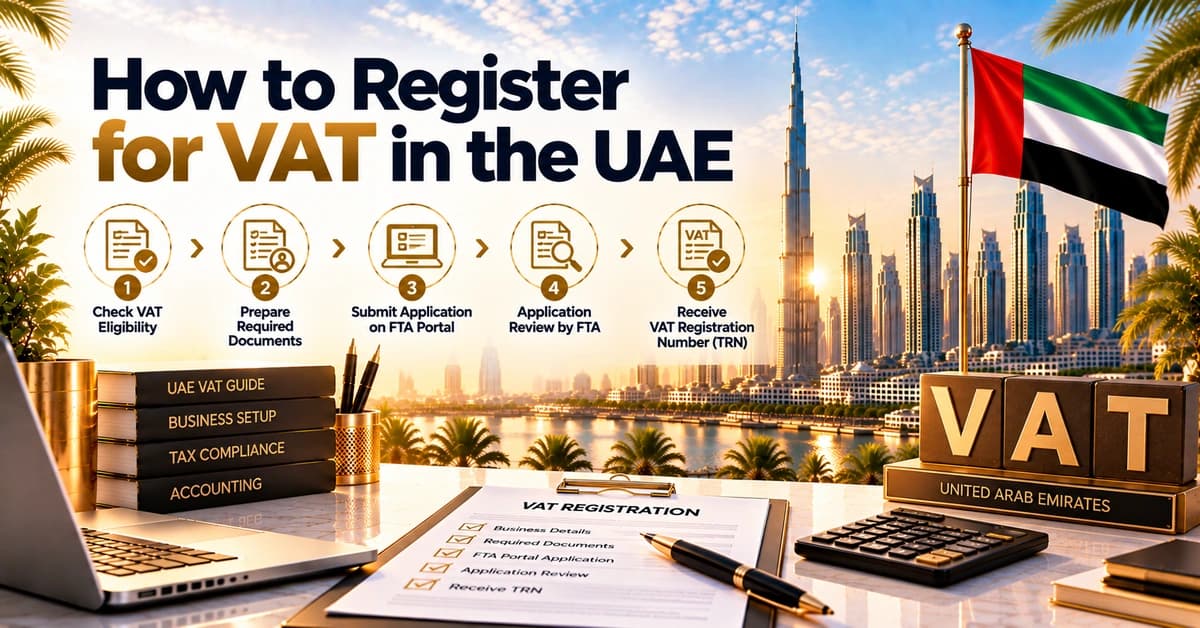
The process is completed online through the FTA's EmaraTax platform. The general sequence is:
Create an account. Register on the FTA portal using a valid email address and set up your login details.
Add your taxable person profile. Enter your legal entity details, trade license information and owner or authorised signatory data.
Start the VAT registration application. Select the VAT registration service from your dashboard.
Complete the application form. Provide information on your business activity, turnover, expected supplies, imports and bank account.
Upload supporting documents. Attach your trade license, identity documents, proof of authorisation and turnover evidence.
Review and submit. Check every field carefully, then declare and submit the application.
Wait for FTA review. The authority may request clarifications or extra documents. Respond quickly to avoid delays.
Receive your Tax Registration Number (TRN). Once approved, you receive a VAT certificate showing your TRN and effective date.
Straightforward applications may be processed within a few weeks, though timelines vary depending on your case and the completeness of your file.
Common Mistakes That Delay or Reject VAT Registration
From our experience supporting founders at Company Setup Consultant, these are the most common problems:
Entering turnover figures that do not match your documents.
Uploading expired or unclear identity documents.
Choosing an inaccurate business activity description.
Applying with a bank account that is not yet active.
Missing the deadline after crossing the mandatory threshold.
Using an email address or phone number that is not monitored, so FTA queries go unanswered.
A clean, consistent application with accurate figures and clear documents is the most reliable way to get a quick approval.
VAT Penalties in the UAE
Compliance failures can be costly. The FTA can impose administrative penalties for issues such as:
Late VAT registration, which carries a fixed penalty.
Late filing of VAT returns, which attracts penalties that can increase for repeat offences.
Late payment of VAT due, which can lead to percentage-based penalties.
Incorrect returns or poor record keeping.
Because penalty amounts and rules can change, always check the latest FTA guidance. The safest approach is to calendar your deadlines from the day you receive your TRN.
What to Do After You Receive Your TRN
Registration is only the start of your VAT journey. Once approved, you should:
Issue tax invoices that meet FTA requirements, showing your TRN, VAT amount and required details.
Keep accounting records, invoices and supporting documents for the period required by law.
Track input and output VAT accurately throughout the period.
File returns and pay any VAT due on time. Our step by step guide on how to file a VAT return in the UAE walks through the process and common errors.
Notify the FTA of any changes to your business details, such as activity, address or ownership.
If your business later closes or its turnover falls permanently below the limit, you may need to cancel your registration. You can learn how in our guide to VAT deregistration in the UAE.
VAT and Corporate Tax: Do Not Confuse the Two
VAT and corporate tax are separate regimes with separate registrations, thresholds and deadlines. VAT is a consumption tax on sales, while corporate tax is levied on business profits. A company may need to register for both. To understand the second obligation, read our guide on how to register for corporate tax in the UAE.
How Professional Support Helps with VAT Compliance
VAT registration and ongoing filing involve deadlines, precise calculations and careful record keeping. Errors can lead to penalties, rejected applications and unnecessary stress. Dedicated business support services in Dubai can handle bookkeeping, VAT registration, return filing and compliance reminders, so you can focus on running your business instead of chasing paperwork.
Why Choose Company Setup Consultant
Tax registration is a regulated, high-stakes step for any UAE business. Company Setup Consultant provides transparent guidance, realistic timelines and practical support from company formation through to VAT readiness. We explain every cost before you commit, prepare your documents carefully and recommend solutions that fit your business, not the most expensive package.
Frequently Asked Questions
Q: Is VAT registration mandatory for all companies in the UAE?
A: No. Registration is mandatory when your taxable supplies and imports exceed AED 375,000 in the past 12 months or are expected to exceed it in the next 30 days. Businesses above AED 187,500 may register voluntarily.
Q: How much does it cost to register for VAT in the UAE?
A: The FTA does not usually charge a standard registration fee, but you may pay for accounting software, bookkeeping or a tax consultant. These costs should be included in your cost to start a business in Dubai budget.
Q: How long does VAT registration take in the UAE?
A: Simple applications are often processed within a few weeks. Timelines depend on the accuracy of your form, the quality of your documents and whether the FTA requests clarifications.
Q: What documents are required for VAT registration?
A: Common documents include the trade license, passport and Emirates ID of the owners or signatories, Memorandum of Association, proof of authorisation, contact details, bank account details and turnover evidence.
Q: Can a new company register for VAT before it starts trading?
A: Yes. A new company that expects its taxable supplies or expenses to meet the applicable limits can apply, based on projected figures and supporting evidence.
Q: What is the penalty for late VAT registration in the UAE?
A: The FTA can impose a fixed administrative penalty if you miss the registration deadline. Penalty amounts can change, so check the latest FTA guidance before you rely on any figure.
Q: Do free zone companies need to register for VAT?
A: Yes, if they meet the registration criteria. Free zone companies are generally subject to the same VAT rules, although certain designated zones have special treatment for specific goods.
Register for VAT the Right Way
Not sure whether your business must register for VAT or how much compliance will add to your startup budget? The team at Company Setup Consultant will review your activity, turnover and structure, then guide you through registration with a clear, itemised quote. We prepare your documents, coordinate the application and support you with ongoing filings so you stay penalty free. Contact Company Setup Consultant today for a free consultation and start your UAE business with full tax confidence.